
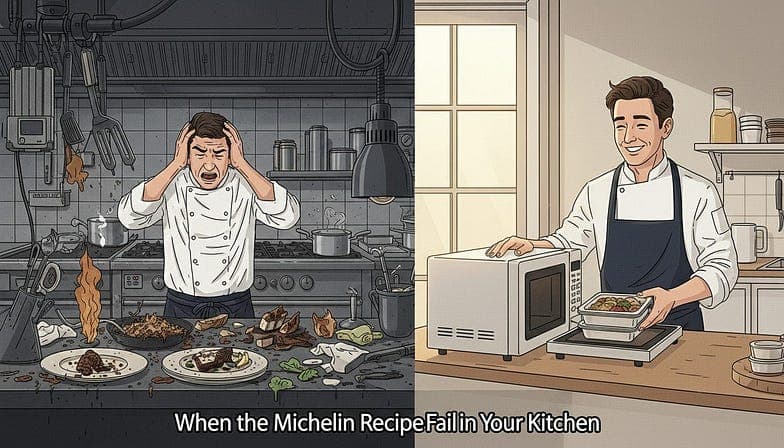
When the Michelin Recipe Fails in Your Kitchen
Why 2026 Marks the End of DIY AI — and the Rise of the AI Meal Kit

Someone hands you a recipe.
Not just any recipe — a Michelin-starred recipe, written by a world-class chef who spent years perfecting every measurement, every technique, every subtle interplay of heat and time.
You follow it carefully. You read every instruction twice. You give it your best effort. And because you’re a builder in the real world, you do what builders always do: you assume the author is honest — and you assume the problem might be you.
But when the result disappoints — when the dish that emerges from your kitchen is nothing like what the chef promised — the chef looks at you and says:
“Why is this all you could make from my recipe?”
That’s the quiet fracture line in modern AI.
Not because the idea is bad.
Not because the math is wrong.
But because the recipe was never written for your kitchen.
The Hidden Tragedy of the Academic Recipe
Most AI papers today are written in perfect kitchens.
Thousands of H100 GPUs humming in climate-controlled data centers.
Pristine, hand-curated datasets scrubbed clean of every inconsistency.
Authors who already know every hidden trick — every calibration that separates success from failure.
And to be fair: controlled conditions are where discovery happens.
The problem begins after publication — when the recipe leaves a lab and enters the messier world of enterprises, hospitals, factories, banks, and governments, where “controlled conditions” are a luxury, not a default.
At that moment, we discover something uncomfortable:
The gap between “published” and “usable” isn’t a rounding error. It’s the main event.
So let’s name the four failure modes that keep turning brilliant ideas into disappointing dishes.

1) Broken Utensils
Infrastructure & Hardware
The paper was cooked in a Michelin-grade kitchen — rows of H100s, terabytes of high-bandwidth memory, perfectly tuned clusters with microsecond latency.
The rest of us?
We’re handed a portable gas burner.
The paper claims O(\log N) efficiency.
The reasoning model promises elegant scaling.
The benchmark curves are clean.
Reality: without a minimum compute threshold — without the industrial-grade infrastructure the authors quietly assume — many of these ideas don’t degrade.
They fail to materialize.
It’s not “a weaker dish.”
It’s a different chemical reaction.
This is why so many teams report the same eerie experience:
- the code runs
- the pipeline completes
- the output appears
- and yet the promised behavior never shows up
Not failure as a crash.
Failure as a missing phenomenon.
2) Spoiled Ingredients
Data Quality
The recipe says:
“Use fresh, organic produce.”
What we actually have is noisy logs, half-scanned PDFs, fragmented documents across systems, schemas that changed repeatedly, and legacy data nobody fully trusts anymore.
With RAG and reasoning systems, this isn’t just inconvenient. It’s fatal — because these models don’t merely need text; they need structure, provenance, and consistent relationships.
When those are broken, you don’t get “slightly worse answers.”
You get hallucination: a spoiled meal that looks edible, sometimes even smells right, but makes you sick if you trust it.
And hallucination is uniquely dangerous because it often passes the first two filters:
It sounds fluent.
It matches expectations.
3) The Missing Pinch of Salt
Engineering RealityThe recipe says:
“Season to taste.”
But it doesn’t say what actually determined the outcome:
- the initialization that stabilized training
- the scheduler that prevented divergence
- the hyperparameter that needed 0.001-level precision
- the undocumented prompt template that moved the needle
- the data trick that was “obvious” inside the lab
Those details don’t fit into eight pages.
They live in notebooks, scripts, and institutional memory.
Not because researchers are careless — but because the publication system rewards novelty, not reproducibility.
This is not a moral failing.
It’s an engineering asymmetry baked into the incentive structure.
4) “If It Failed, That’s Your Kitchen”
Responsibility Gap
When the dish fails, the response is familiar:
“The math is sound.”“The theory is correct.”“Your prompt must differ.”“Your distribution doesn’t match ours.”“Your compute has bottlenecks.”
The recipe is declared perfect.
The failure is declared yours.
Most researchers don’t intend harm.
But the system still produces structural abdication: the distance between “published” and “usable” is measured in person-years, and no one owns that gap.
So the burden moves downstream — onto product teams, infra teams, compliance teams… and that one staff engineer who becomes “the person who makes papers work.”
Press enter or click to view image in full size

The Paper Explosion
Progress — and the “Noise Tax”
One more force makes everything worse: volume.
The Stanford AI Index doesn’t describe it as a vibe. It describes it as math.
- Between 2013 and 2023, annual AI-related publications grew from roughly 102,000 → 242,000.
- Over the same period, AI’s share of computer science papers rose from 21.6% → 41.8%.
That growth is real progress.
But it also imposes a cost: selection cost.
As papers multiply, teams increasingly end up here:
- you read more papers, but your product gets less stable
- you chase SOTA, but reproducibility and operability degrade
- ideas become abundant, but deployment slows down
I call this the Noise Tax:
more research does not automatically translate into more usable innovation.
Where the Money Goes Now
From papers → operations
AI Index 2025 reports that U.S. private AI investment reached $109.1B in 2024.
What matters isn’t just that it’s big.
It’s what it buys.
Investors increasingly ask:
- Does this end as research — or as an operable product?
- Is it a demo — or a repeatable deployment unit?
- Can you bound cost, latency, observability, and auditability?
Papers still matter.
But the destination of authority is shifting — from peer review to operational success.
And that shift has a consequence.
The Pivot
Why the market stops cooking — and starts buying meal kits
The four failure modes make implementation expensive.
The Noise Tax makes chasing papers unsustainable.
So by 2025, enterprises stopped asking:
“How do we implement this paper?”
They started asking:
“Why are we implementing anything from scratch at all?”
That’s the moment the DIY era quietly ended.
Not because ambition died — but because the implementation gap stopped being romantic and started being expensive.
And that refusal to cook didn’t create stagnation.
It created a market category: runnable bundles — systems designed to survive imperfect kitchens.
So the real 2026 signal is simple:
Packaging beats ingenuity.
2026 Market Watch — Four signals the meal-kit era is already here
If the DIY era died for economic reasons, the market’s response is visible in four concrete places — places that don’t speak in metaphors, but in product strategy.
Signal #1 — Ingredient Standardization
NVIDIA NIMs
For years, NVIDIA sold ovens. With NIM (Inference Microservices), it began selling meals.
Model configuration, dependencies, runtime optimization — packaged into a deployable microservice.
This directly addresses Broken Utensils and Missing Salt:
- you don’t reverse-engineer the correct toolchain
- you don’t guess the hidden tuning
- you run the same prepared base as everyone else
Don’t tune the model. Run the container.
This is not convenience.
It’s the end of hidden seasoning.
Signal #2 — Household Ingredients
Small Language Models (SLMs)
SLMs proved something quietly revolutionary:
you can right-size the recipe to the kitchen.
They address Broken Utensils in the most direct way possible:
they move the baseline from “restaurant-only” to “home-cook viable.”
Not dumbing intelligence down — making it bounded, predictable, and cheaper to operate. Which is what real systems demand.
This is the end of kitchen envy.
Signal #3 — Appliances, Not Parts
“AI in a Box”
Pre-installed LLMs, pre-configured RAG pipelines, pre-tuned inference stacks, security baselines — shipped as a validated bundle.
This addresses Spoiled Ingredients and Responsibility Gap:
- someone is implicitly claiming ownership of the gap
- the buyer gets a path from “messy ingredients” to “consistent output”
- and there’s a clear accountability surface when it breaks
Bundles don’t just ship software — they ship someone to call (and someone to blame).
Appliances win because they reduce interpretation, integration effort, and blame diffusion.
This is the end of “not my kitchen.”
Signal #4 — Cooking for Everyone
Ollama & LM Studio
One command. No cloud. No DevOps.
AI crossed the line from specialist tool to appliance.
And that changes everything — because it expands the builder population beyond ML engineers: analysts, researchers, designers, writers, students.
When operators multiply, markets do what they always do:
they standardize.
This is the end of gatekeeping.

Why This Is Happening Now
The Two Drivers
1) Sovereignty
Organizations no longer want to send their data to someone else’s kitchen.
Regulation is one part.
But the deeper driver is control.
Meal kits work inside your kitchen.
They don’t require exporting ingredients to a distant restaurant and hoping you get the dish you wanted back.
2) The Implementation Gap
Papers multiply. Senior “paper-to-production chefs” do not.
Hiring these chefs is expensive. Keeping them is harder.
So buying a kit that tastes like the chef’s work becomes economically rational.
What 2026 Actually Opens
A New Hierarchy of Value
This is not the death of research.
It’s the re-pricing of value.
From here on:
1) Authority shifts from discovery → execution
- Before: “We hit SOTA.”
- Now: “This runs under constraints.”
2) Trust shifts from papers → operations
- Before: citations, prestige, affiliation.
- Now: uptime, rollback, monitoring, cost ceilings, failure mode documentation.
3) Innovation shifts from novelty → reliability under constraint
- Before: “+15% on a benchmark.”
- Now: “+15% even when your PDFs are messy, your GPU is old, your compliance is strict, and your team is small.”
These shifts only become truly visible when you talk to the people actually running these systems day to day.

Micro-scenes from the real world
In a hospital, the model isn’t judged by how clever it is — but by whether it refuses to answer when it can’t cite the chart correctly, because “mostly right” is still malpractice.
In a government office, procurement doesn’t move because a demo looked impressive — it moves when someone can attach an audit report that proves citizen data never left jurisdiction.
In a factory, the “best model” is not the one with the highest benchmark score — it’s the one that keeps working when sensors drift, logs are missing, and the night shift is understaffed.
We will see fewer miracle headlines — and more quiet infrastructure victories that actually reshape industries.
The world doesn’t need AI that is impressive.
It needs AI that is survivable.

Closing
The AI field is not starved for intelligence.
It is drowning in unconsumed insight.
We don’t need more recipes.
We need systems that acknowledge reality — that intelligence only matters after it survives the kitchen.
The AI Meal Kit is not a compromise.
It is an admission that the gap between theory and practice is now the true frontier.
And whoever closes that gap will decide what AI actually becomes.