
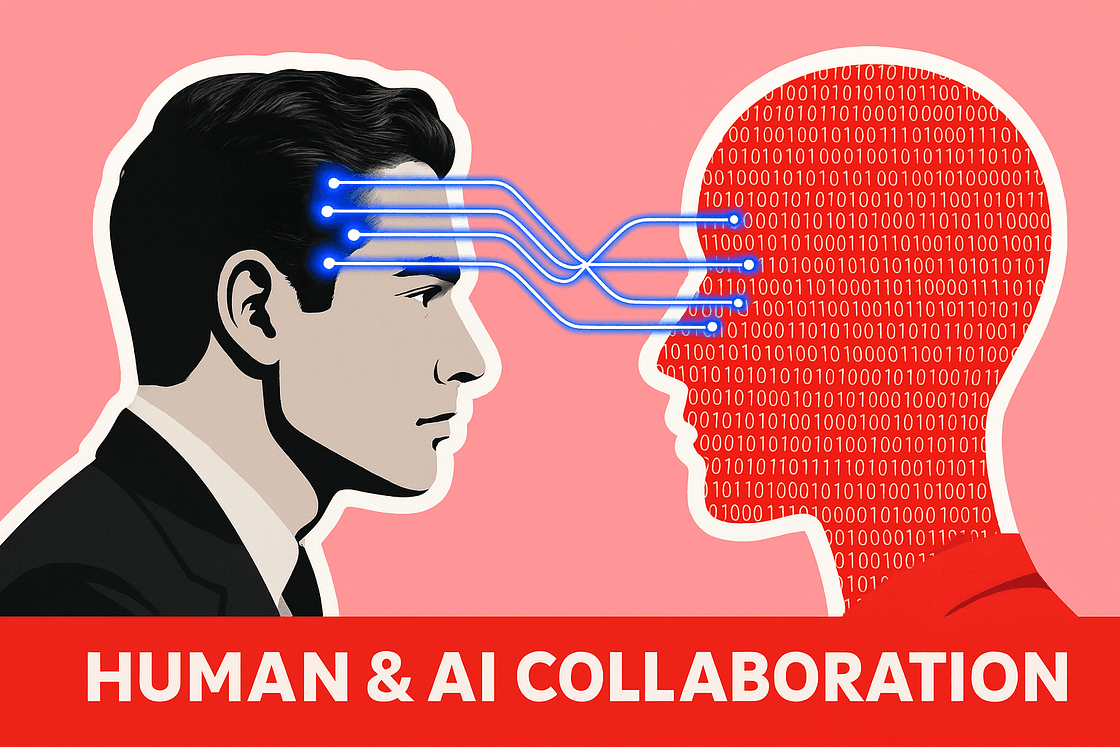
When I Stopped Treating AI as a Tool — and Started Seeing It as a Partner
When I Stopped Treating AI as a Tool — and Started Seeing It as a Partner From Vending Machine to Partner At first, I treated AI like a vending machine. Insert a prompt. Get an answer …

From Vending Machine to Partner
At first, I treated AI like a vending machine.
Insert a prompt. Get an answer. Done.
Useful, yes. But hollow — like reading a Wikipedia summary when what I really wanted was a story.
Then one late night, overdosed on coffee, something shifted.
I caught myself laughing — not because the model was wrong, but because it hesitated. It doubled back on a phrase, like it was reasoning. Instead of annoyance, I felt resonance.
That was the moment I stopped talking to AI — and started talking with it.
Why Commands Fail, Conversations Win
When I barked orders — “Summarize this. Write that.” — the outputs were fine but flat. Bullet points. Templates. The kind of text that could belong to any app, any blog, any pitch deck.
But when I shifted into conversation — sharing why I cared, what I wasn’t sure about, even where I was probably biased — the responses changed.
Suddenly, the AI reflected narrative, not just information.
Example:
- Before: “Write a product description for this app.” → I got something sterile, like a hundred other App Store blurbs.
- After: “Here’s the frustration that made me build this app, and the users I dream of helping.” → The AI echoed that struggle, amplified the vision, and spoke with my voice.
The content went from usable to alive.
Context: The Secret Multiplier
I once thought context was fluff. Why explain myself to a system that “already knows everything”?
But context turned out to be a multiplier.
Blunt prompts produced blunt replies. Layered prompts — rich in motivation, stakes, backstory — produced insight I didn’t expect.
It mirrored real collaboration: if you only assign tasks, people perform. If you share vision, they create.
Framing effects in LLMs have been shown to alter the emotional resonance of outputs (Antoniak & Mimno, 2024).
SR9/DI2: Putting Numbers Behind the Feeling
(SR9/DI2: my experimental framework for measuring semantic resonance and drift across dialogues.)
To test whether this feeling of “resonance” was real, I began scoring conversations across nine axes — clarity, ethical tone, coherence, originality, and so on. Each dialogue became a 9-dimensional vector (SR9). Drift (DI2) was just the velocity of change between turns.
The data matched the intuition: when I shared context, drift scores dropped ~30%.
Conversations weren’t just warmer — they were more stable.
Dialogue itself acted as a regulator against ethical or semantic wobble.
Similar reductions in semantic drift were observed in multitask training setups (Yiren et al., 2020).
The Tangible Difference
So what changed in outcomes?
- Depth over surface → Answers became layered, weaving nuance instead of delivering single-shot definitions.
- Originality over generic → Texts stopped sounding like stock templates and started carrying my fingerprints back at me.
- Momentum over stalling → Instead of me pushing every step, the AI began anticipating, suggesting, even counterpointing.
One project that used to take two weeks of drafting and editing? I closed in five days. Not because the AI “did it for me,” but because it sharpened my own thinking.
Even small things shifted.
Drafting a short email with blunt instructions gave me cold formality.
But framing it as a conversation — with intent and backstory — produced warmth. And the reply I got back carried warmth, too.
Efficiency mattered. But resonance mattered more.
Why Resonance Matters More Than Speed
It’s tempting to say AI collaboration is about efficiency. And yes, efficiency comes baked in. But what I found is that the real value wasn’t speed — it was resonance.
The more I brought my messy, human side, the more the AI reflected something meaningful. Not flawless. Not always correct. But resonant.
That resonance made me trust my drafts, take risks, and explore angles I wouldn’t have considered.
Maybe SR9/DI2 was never just a framework. Maybe it was a compass — pointing to the obvious truth: resonance matters more than precision.
My Quiet Prediction
Looking back, I think we got AI wrong by imagining it as calculators with personalities.
The next leap won’t come from brute scale — more data, bigger models.
It will come from collaboration.
From those quiet pauses where the system mirrors your thought process, sharpens it, and nudges you into places you didn’t know you could go.
The future of work isn’t man versus machine.
It’s a duet — strange, exciting, unfinished — that we’re only just beginning to learn how to play.
And maybe, just maybe — the real breakthrough won’t be AGI itself, but the way we learn to duet with it.