
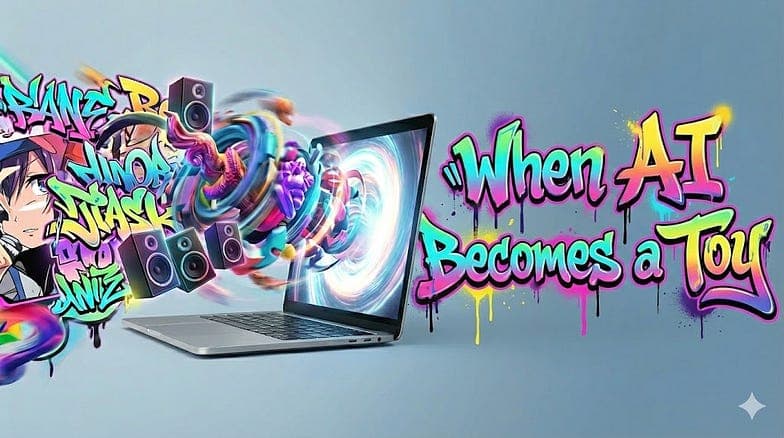
When AI Becomes a Toy
Why the Current AI Craze Was Inevitable — and Why It Cannot Be the Endgame

🧠TL;DR
AI’s boom isn’t a failure.
It’s a play phase.
Tools like Sora and Midjourney help society
get comfortable with AI.
The real danger starts
when play is confused with understanding.
In practice, AI is still consulted — not delegated.
What comes next won’t be flashier.
It will be boring, structured, and accountable.
👉 Enjoy AI as a toy — but demand structure before trust.
1. When AI Shows Up as Play, Not Power

Artificial intelligence is everywhere right now —
just not where many people once expected it to be.
Instead of being confined to research labs
or enterprise back offices,
AI’s most visible presence now lives on social feeds —
in AI-generated music videos
and endlessly remixed images.
For a growing segment of the public,
AI has evolved from an instrument of productivity into something
closer to a toy: something to play with, remix, post, and move on from.
This has triggered a familiar cultural reaction cycle.
First, fascination. Then skepticism. Finally, dismissal.
“This is amazing.”“This is overhyped.”“This is just a toy.”
Yet this framing misses the deeper transformation unfolding beneath the surface.
2. Play Is How Technologies Enter Society

Historically,
Transformative technologies almost never enter society through responsibility.
They sneak in through play.
Photography didn’t begin as journalism.
It began as filters, portraits, and novelty.
Video didn’t arrive as education.
It went viral as dance clips and short entertainment.
Even the internet didn’t start as infrastructure.
It spread through games, chatrooms, and things
nobody took very seriously at first.
AI is following the same, familiar path.
Not through policy decks or enterprise rollouts,
but through creation that feels easy, fun, and a little ridiculous.
Play lowers fear.
Play lowers learning costs.
Play makes complexity feel approachable — without asking anyone to understand how it actually works.
Seen this way, AI-generated music videos and visual experiments are not a failure of seriousness.
They are a social onboarding layer.
This phase wasn’t a mistake.
It wasn’t hype gone wrong.
It was inevitable.
3. Hype Has a Structure — and a Cost
The real problem begins when play is confused with understanding.
That is where the work of Dan M. Kotliar matters.
Kotliar doesn’t argue that AI is fake or useless.
He argues something more uncomfortable: hype rewires roles.
Through his STATE framework,
Kotliar shows that hype doesn’t just exaggerate capability.
It quietly misassigns responsibility.
AI becomes an agent instead of a system.
A decision-maker instead of a tool.
A creator instead of an instrument embedded in human structures.
Nothing breaks immediately.
But expectations inflate.
And trust begins to thin.
Trust rarely collapses loudly.
It erodes silently.
4. Using AI Is Not the Same as Understanding AI

From this distortion, a dangerous illusion begins to form:
“I made something with AI.Therefore I understand AI.”
That leap feels natural.
It is also wrong.
Prompting is not reasoning.
Selecting outputs is not accountability.
Posting results is not authorship.
This illusion is now easy to spot.
On TikTok and Instagram, AI-generated videos flood feeds so quickly
that novelty barely has time to register before it disappears.
On LinkedIn, the problem isn’t speed but sameness:
AI-written posts — polished, verbose, and instantly forgettable —
pile up until nothing stands out.
This phenomenon is often called AI “slop.”
Not because the models are bad.
But because responsibility has quietly dropped out of the loop.
When consequences disappear, output explodes.
Meaning collapses.
Novelty turns into noise.
5. Creativity: Where the Boundary Becomes Subtle
At this point, a reasonable counterargument deserves acknowledgment.
In scientific domains,
AI systems have discovered unexpected patterns —
in protein folding, materials science, and other fields —
that humans might not have found unaided.
In that sense, AI can display a form of analytical creativity.
This matters.
But as researcher Advait Sarkar has argued,
creativity is not defined by novelty alone.
It emerges from a relationship between expression, reception, and community, grounded in intent and responsibility.
AI can contribute to creative processes.
It can even catalyze new directions.
What it cannot do
is own the consequences of its outputs.
That distinction is not philosophical hair-splitting.
It is the boundary between a tool and an agent.
6. Why Institutions Remain Cautious
Public enthusiasm may peak,
but institutions behave very differently.
In practice, AI is rarely treated as autonomous.
Enterprise deployments — from companies like IBM and Google —
position AI as assistive: drafting, summarizing, recommending,
while final judgment remains human.
That pattern is not accidental.
Across peer-reviewed research,
the boundary is the same.
AI is embraced for ideation, but stops short at responsibility-heavy, customer-facing decisions.
As one study puts it:
“The gap is not technological.It is institutional and psychological.”
In practice, this distinction is simple.
AI is consulted —
not delegated.
7. Beyond the Spectacle

Something is starting to shift.
AI-as-play is no longer accelerating.
It is plateauing.
Not because AI is disappearing,
but because excess has done what excess always does —
it has dulled attention.
Feeds are full.
Outputs blur together.
What once felt surprising now feels expected.
This is not decline.
It is gravity.
The center of weight is moving:
- From fun → reliability.
- From novelty → trust.
- From spectacle → accountability.
8. What Comes After the Hype

The next phase of AI will not trend on social media.
It will live in audit logs.
In reproducible pipelines.
In governance layers, rollback mechanisms,
and clearly defined responsibility.
It will look boring.
That is the point.
Boring is what trust looks like.
AI will matter not because it can generate endless content,
but because it becomes something we can safely rely on.
Final Thought

Enjoy AI as a toy.
Play with it. Experiment. Remix.
But when you are asked to trust it —
to deploy it, to depend on it, or to let it decide —
demand structure.
Play is the doorway.
Structure is the house.
And real progress only happens once we step inside.
So let’s play at the door a little longerbut start building the house today.