
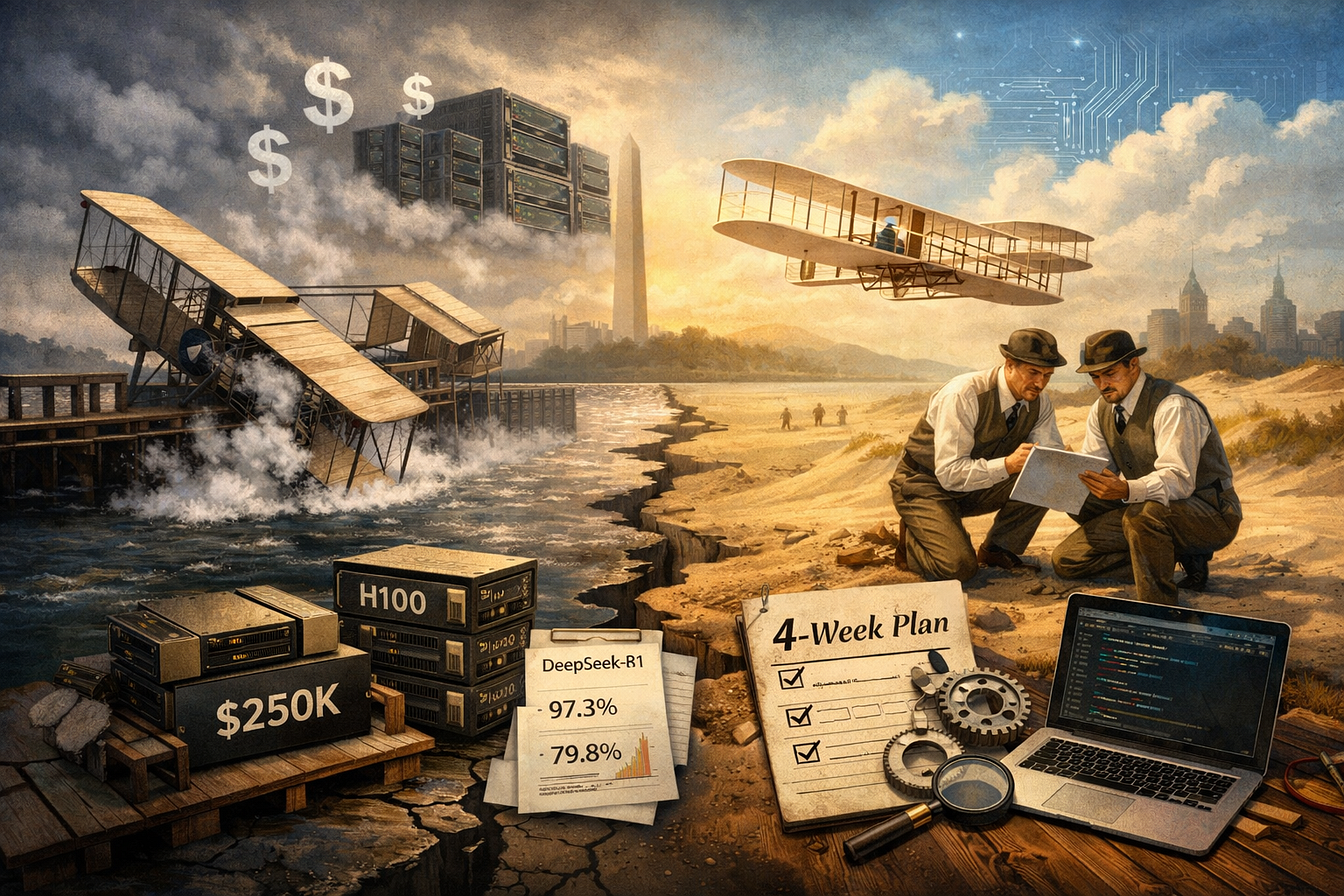
The AI Flight Crash: Why 2026’s Hottest Papers Can’t Take Off — and what actually ships
Langley spent $50,000 and sank — the Wright Brothers flew for <$1,000. Here’s a 4-week build plan I’ve seen actually ship.

The Steam and the Sink

In December 1903, Samuel Langley’s Great Aerodrome sat atop a houseboat on the Potomac River. It was a masterpiece of 19th-century elite science, backed by $50,000 in government grants and the era’s finest theoretical minds. The catapult fired. The machine groaned.
Instead of soaring, the Aerodrome plunged into the icy Potomac. Steam hissed from its drowned engine as it sank like a lead weight.
Thanks for reading Flamehaven Insights! Subscribe for free to receive new posts and support my work.
Nine days later, in the windy dunes of Kitty Hawk, two bicycle mechanics — Orville and Wilbur Wright — took flight. They didn’t have grants. They had a home-built wind tunnel, tight feedback loops, and an obsession with control and efficiency over raw power. They spent less than $1,000.
In February 2026, the AI industry is reliving the Potomac plunge.
We have magnificent “catapults” like DeepSeek-R1 — systems that look incredible in papers — yet stall in real deployments due to timeouts, queues, and brittle stacks.
For the average developer, the gap between the PDF and the Product has rarely felt wider.
1. The Reasoning Revolution That Wasn’t (Yet)
In January 2025, DeepSeek-R1 sent shockwaves through the community. It wasn’t just another LLM; it signaled a step toward models that can sustain longer chains of thought.
The benchmark story is undeniable:
- MATH-500: 97.3% (arXiv:2501.12948v1)
- AIME 2024: 79.8% Pass@1
At the same time, the research surface area around “reasoning” has exploded. — at least by any practical scan of arXiv titles, GitHub tags, and discussions. The promise is clear: AI that can carry multi-step logic.
But months later, the GitHub Graveyard tells a different story. If reasoning had really crossed a threshold, we should see it reflected in the open ecosystem: runnable code, reproducible setups, and systems that survive first contact with a local machine.
So instead of reading another paper, I started cloning repositories.
2. The GitHub Reality Check

I spent several dozen hours spot-checking 50+ repositories tagged with “DeepSeek-R1” or “reasoning model.” I didn’t just read the READMEs — I tried to run them.
Three patterns kept repeating (with the caveat that this is a personal sample, and sampling bias is real):
◾The 12-hour dependency wall
- Marathons ending in the discovery that “production-ready” scripts require specific library versions that no longer exist or conflict with modern CUDA kernels.
◾The “Wrapper” Trap
- A large portion of repos aren’t running models at all — they are thin API facades. They don’t reduce cost; they repackage it while adding another point of failure.
◾The VRAM Mirage
- “Local inference” demos that quietly require extreme memory footprints ($480GB+$ VRAM). Even when they run, they don’t run in a way you’d trust with a production SLA.
◾Key takeaway:
- A tiny minority of implementations are runnable on consumer hardware (<$5K) without major compromise. The gap between “demo works” and “system ships” is where most 2026 projects go to die.
3. The $250,000 Wall

Why can’t you download the future?
Because the future is often gated by the modern “Langley catapult”: hardware and operational requirements that ignore the reality of independent builders.
◾The Compute Tax (inference reality)
- To run full-scale frontier variants at high throughput, you need serious GPU capacity — commonly multi-H100 setups. At $25,000 per GPU and roughly $3.00/hour for cloud rentals, the capex alone hits six figures.
◾The Distilled Compromise
- While 7B and 70B distilled versions run on prosumer cards like the RTX 4090, teams find that “it runs” is not the same as “it keeps the reasoning soul.” Performance often drops significantly when faced with real-world edge cases.
◾The Tool-Calling Gap
- Turning hard math into a system that acts — querying DBs or calling functions — requires a second “action” layer, adding latency and cost that benchmarks don’t measure.
4. The 10% Myth

The belief that reasoning AI belongs only to elite labs with $250K clusters is one of the biggest misconceptions in tech today.
It sounds plausible — until you look at how real systems are actually built.
Reality check:
◾llama.cpp
- how far a single developer can push local inference — by optimizing for constraints instead of scale.
◾Z3 and other solvers
- free, open, and brutally precise — especially when used as logic filters rather than generative engines.
◾LangChain
- started as a small project solving a concrete tooling gap that production teams actually had.
None of these succeeded by having more GPUs.
They succeeded by optimizing for the environment they were deployed in.
The problem, then, isn’t just hardware.
It’s incentives.
Academic research and production systems are optimized for fundamentally different objective functions.

Once you see this mismatch, the pattern becomes obvious:
we keep trying to deploy systems that were never optimized to survive deployment.
5. The “Wright Brothers” Pattern — and one reference I know well

The solution isn’t a bigger catapult.
It’s production-first design: separate roles, enforce invariants, and contain failure modes. This means treating the model as a hypothesis generator, not the final authority.
One working reference that implements this exact pattern is the open project Flamehaven-LOGOS. LOGOS doesn’t chase leaderboard dominance; it chases halt-safety. It uses an evidence-atomization pattern:
- Generate: A smaller model proposes a reasoning chain.
- Verify: Outputs are grounded through explicit scoring (e.g., Omega-style metrics).
- Gate: If grounding is weak or a loop is detected, the system refuses to answer.
It prefers safe silence over confident nonsense. In a stable product, that is the only trade worth making.
6. The Wright Brothers Playbook (4-Week Roadmap)
Stop reading PDFs. Start building.
◾Week 1: Pick Your Constraint
- Choose a narrow domain (e.g., “contract validation”).
- Budget: $500–$2,000.
- Goal: verification accuracy, not “global AGI.”
◾Week 2: Build the Hybrid Stack
- Input Gate: Regex/parsers/schemas to sanitize queries.
- The Brain: a 7B-class model you can run reliably.
- The Logic: deterministic checks — solvers/rules/parsers/evidence gates.
◾Week 3: Quality Gates
- Implement drift checks (use a threshold that fits your domain — treat numbers like JSD<0.05 as examples, not dogma).
- Add a “Halt” command: if the model loops for >10 seconds, fail gracefully.
◾Week 4: Launch the Prototype
- Run it offline. No APIs. No timeouts.
- Measure cost-per-success and mean latency.
- Publish what you learned — not as a claim, but as a trace of flight.
Conclusion: Fly While They Sink
The 2026 AI boom is real.
But the most important work isn’t happening only in labs with the biggest catapults.
It’s happening in bicycle shops — the garages where engineers build systems that hold under real-world constraints.
Samuel Langley had the fame, the money, and the Smithsonian.
But the Wright Brothers had the flight. The catapult is sinking in the Potomac.
It’s your turn to take off.

Thanks for reading Flamehaven Insights! Subscribe for free to receive new posts and support my work.
References (Verified Feb 2026)
- DeepSeek-R1 Benchmarks: arXiv:2501.12948v1
- Hardware pricing examples: H100 cluster pricing (Jarvislabs / GMI Cloud as reference points)
- Verification approaches: Z3 / solver docs; production gating patterns
- Deployment/timeout pain: Azure community threads (Q&A / Learn forums)
Share
Related Reading
AI Signals & Market Shifts
Is MCP Really Dead? A History of AI Hype — Told Through the Rise and Fall of a Protocol
AI Signals & Market Shifts
AI Isn’t Killing Your Expertise. It’s Just Moving the Paywall.
AI Signals & Market Shifts