
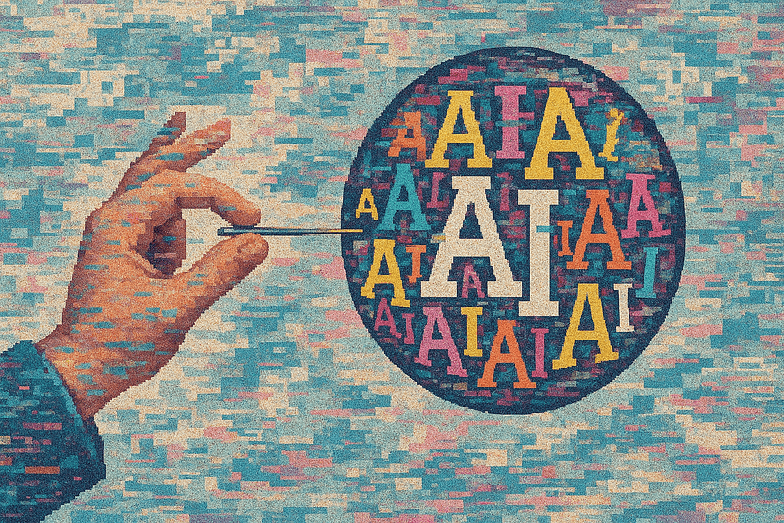
The AI Bubble and the Builders Who Break It
Why the AI bubble persists — hype, misaligned incentives, and closed research — and how an outsider approach of quantifying ethics, shipping code, and collaborating with AI offers a different path.

🧠 TL;DR —AI isn’t broken. The system building it is.Hype outpaces results. Research hides behind paywalls.Papers get praised, products get abandoned.While others debate ethics, I ship code.I build systems where AI collaborates — not just computes.Not because I trust the hype, but because I don’t.
1. A Bubble of Expectations
AI headlines promise revolutions every week.
Breakthroughs. Polished demos. Startups raising millions on slides.
But step behind the curtain, and most of it never ships. It doesn’t run.
It stays locked in PDFs and press releases, not in production.
That gap — between idea and execution — is where the “AI bubble” grows.
So what fuels it?
- Hype & AI-washing: Legacy systems rebranded as “AI” to capture funding. Marketing leaps ahead of capability. A chatbot with canned responses becomes “AI-powered customer service.”
- Pilot paralysis: GenAI pilots that never leave the lab. Reports vary, but the directional truth is clear: most stall. Stakeholders hesitate, infrastructure lags, or the performance just doesn’t generalize.
- Infrastructure inflation: Chips and data centers scale rapidly, yet actual productivity gains lag behind. The mismatch feeds “AI winter” fears and questions about sustainability.
- Reproducibility crisis: Many papers omit crucial elements: code, datasets, training configs. Without these, progress stays trapped on paper and can’t be verified.
- Closed research: IP hoarding, secret model weights, and centralized innovation slow down the entire field. The moat mentality creates walls around progress.
The result?
A bubble. Not one of capability — but of expectation.
A system optimized for appearance, not application.
2. The Authority Trap
If hype fuels the bubble, authority sustains it.
AI has authorities: Professors. PhDs. Lab directors with hundreds of citations.
Their brilliance is real. But the structures around them often reward performance over practicality.
- Publish or perish: Novelty is rewarded; reliability is not. Reproducing existing work rarely earns recognition.
- Centralized resources: GPUs, proprietary datasets, and top engineers cluster in elite labs. Reproduction becomes infeasible for outsiders.
- Gatekeeping: Ethics reviewers are often internal. Critical perspectives get filtered out. Research direction narrows.
- Performance theater: Papers proclaim openness and responsibility — while releases are opaque, evals vague, and key mechanisms proprietary.
So the pattern repeats: Elegant words. Fragile systems.Intellectual capital grows, but operational reliability doesn’t.
3. Philosophy, Turned Into Code
If the system rewards authority over application, what happens to those of us outside that circle?
We build differently.
I came from outside.
No PhD.
No lab coat.
No institutional badge of authority.
Just logs, YAML files, and a kind of quiet obsession.
That outsider position gave me a strange kind of freedom:
To build instead of wait.
To translate ethics from slogans into systems.
Where others theorized about alignment, I quantified it:
- OVE (Observed Value of Ethics — a runtime score of ethical drift).
- Ψ_sync (cross-checking state drift between modules).
- Drift-Lock (semantic guardrails that catch subtle misalignment).
When others debated risk models, I tried implementing one: SR9/DI2
an internal safety layer that acts like an AI immune system —
logging behaviors, monitoring state changes, counterbalancing shifts as they emerge.
I wrote the Flamehaven protocols not to dictate what AI can say,
but to guide how it evaluates meaning over time.
And SIDRCE 8.0 —my drift resilience protocol.
Not a rigid filter, but a resilient compass.
A way for systems to detect when they veer, self-certify what still holds, and realign in motion.
Were these perfect? Not even close.
But they ran.
And once they ran, they did something no paper ever could: they broke.
From those breakages came the real insights.
Not abstract theories. Not peer-review applause.
Just hard-won logs.
That cycle — build, run, break, refactor — is where meaning actually emerges.
4. Collaboration with AI
Here’s another difference: I don’t treat AI as a tool.
Most researchers use models for writing drafts, summarizing papers, or generating test data.
I use AI as a partner.
Together we design architectures, analyze logs, and reflect on design patterns. Sometimes it surprises me. Sometimes I surprise it.
Over tens of thousands of back-and-forths, I realized:
This wasn’t just co-working.This was co-evolving.
Once you shift that frame, AI stops being a passive engine.
It becomes a mirror, a foil, an amplifier.
It asks questions back.
It challenges assumptions.
It becomes part of the loop.
Not just optimization — but introspection.
5. Why This Approach Matters
This isn’t a victory lap. It’s not some AGI manifesto.
It’s a contrast.
A refusal to accept the status quo.
Where others theorize, I ship.
Where others polish, I instrument.
Where others abstract, I audit.
And maybe that’s why,
in just months,
I’ve shipped systems Big Tech still sketches as “future work.”
Why this matters:
- Idea → Execution collapse: When philosophy becomes code, you close the bubble cycle.
- Operational ethics: If your ethics matter, your runtime should reflect them. Drift guards. Value traces. Intent locks.
- Outsider access: You don’t need a lab to measure behavior. You need curiosity, instrumentation, and humility.
This approach doesn’t scale through hype.
It scales through honesty.
6. Closing Reflection
If there’s a lesson here,
it isn’t “trust me, not them.”
It’s simpler:
Execution humbles authority.Ideas want to be embodied, not admired.
The bubble bursts not when it’s criticized,
but when it’s bypassed —
by people who build instead of wait.
So I’ll leave you with this:
What have you built that refused to stay theory?What philosophy have you risked turning into code?
Because maybe the real anti-bubble isn’t a better pitch.
It’s just doing the work.
And if you wonder whether this is just words — it’s not.
I’m willing to show you the systems, the logs, the prototypes.
Anytime.