
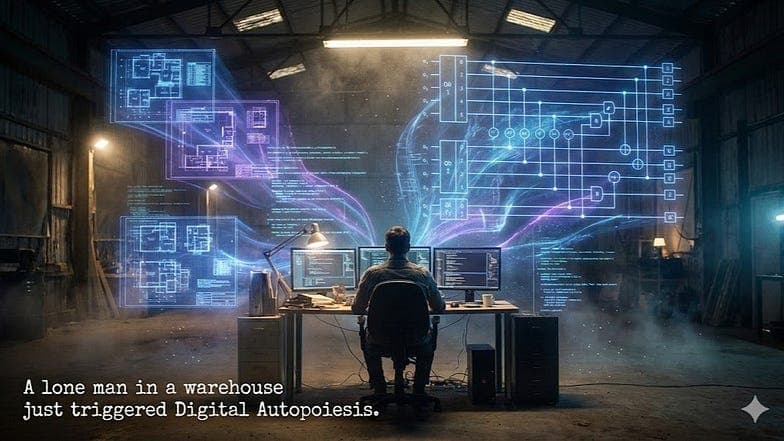
My Code Fixed Itself at 11PM
A “Quantum Engine” is a dramatic name. Here’s the un-dramatic story.

Prologue
At 11PM, my system rewrote itself.
No crash. No alert. Just a quiet patch I didn’t ask for.
I’m not going to sell this as “the future.”
I’m not even sure it was a good idea.
But it happened. And it taught me something about a kind of failure we don’t name well.
The failure mode nobody dashboards for
Every developer knows the feeling.
CPU is fine.
Memory is fine.
No obvious errors.
And still… outputs get strange. Latency creeps. Retries climb.
The system is up, but your trust is down.
I used to call that “a bad day.” Now I call it drift.
Not a crash. Not a clean regression you can point to in one PR.
More like a slow leak you notice because your stomach tightens before your charts move.
Drift isn’t a crash. It’s a slow leak you notice because your stomach tightens before your charts move.(More info below Link Page)
If drift is real, why do we keep treating system health like a binary?
That question pushed me somewhere unexpected.
Sailing the Sea of AI Lies & Hallucinations — Navigating Truth with SR9/DI2“What if the AI you’ve trusted implicitly — had never been telling the trut?”
medium.com
I didn’t want post-mortem metrics. I wanted a meter for confusion.
I tried the usual signals first.
Error rates.
Latency percentiles.
CPU and memory trends.
They’re useful — but mostly after something has already gone wrong.
What they didn’t capture was that mixed state where a system still runs but feels less trustworthy by the hour.
That word, mixed, matters.
In quantum mechanics, a pure state is clean and concentrated.
A mixed state is uncertain — a blend rather than a single story.
There’s a way to measure how mixed a state is: Von Neumann entropy.
Before the eye-rolls:
I’m not claiming my server is quantum.
I’m borrowing a mathematical language built to describe uncertainty inside complex states.
Low entropy feels like a sharp photo.
High entropy feels like several exposures blurred together.
Drift, in practice, feels a lot like that blur.
So I asked a very practical question:
Can I turn that blur into a number before something breaks loudly?
The bridge: logs → angles → entropy
Quantum circuits don’t understand English logs.
They understand numbers — rotation angles.
So I built a deterministic bridge:
- Take a snapshot of logs (text).
- Hash it into a stable integer.
- Use that as a deterministic seed.
- Map generated values to rotation angles on an N-qubit circuit.
- Compute Von Neumann entropy of the resulting state.
Same text in. Same angles out. Same entropy.
No vibes. No randomness masquerading as insight.
Core idea in code:
This doesn’t translate meaning into physics.
It produces a reproducible geometric fingerprint of a system snapshot — something I can track over time.
Does that fingerprint correlate with drift?
Often enough that I kept going.
Okay, here’s where it got weird.
Measuring entropy is interesting.
Acting on it is the dangerous part.
Normally, rising uncertainty means: wake a human.
Instead, I wanted to test a tightly bounded loop:
- detect drift
- propose a small intervention
- apply it safely
- test
- log everything
Self-modifying code isn’t magic. It’s automation with teeth.
I gave the system one surgical tool: Python’s
ast (Abstract Syntax Tree).AST lets you modify structure, not just text.
You can limit what kinds of changes are even possible.
Then I did something reckless but honest.
I left it running and walked away to get coffee.
When I came back, the terminal said:
- Created:
src/dfi_meta/middleware.py
- Modified:
src/dfi_meta/architect.py
Not formatting.
Not imports.
Actual architecture.
My first reaction wasn’t excitement.
It was physical discomfort — like realizing you might’ve left the stove on.
Then the engineer in me took over:
Show me the trail.
Here’s the genesis log the system wrote:
That number isn’t universal.
It’s just my reading, in my setup, on that night.
But it was the first time a system didn’t just degrade silently.
It noticed it was getting mixed.
It tried to intervene.
And it left evidence.
That’s the part I can’t unsee.
What this is not
Let’s draw some hard boundaries.
This is not quantum advantage.
This is not code consciousness.
This is not a promise that self-modifying systems are safe.
It’s an experiment:
a drift signal plus constrained mutation, wrapped in tests and logs.
And it’s fragile.
Self-modifying systems can amplify mistakes.
They can optimize around tests instead of toward truth.
Which makes the real question uncomfortable:
Can we build self-repair without losing accountability?
The question that keeps me up
If loops like this ever become boring and reliable, a few futures open up:
- A vulnerability lands at 03:11, and by 03:14 there’s already a patch candidate with an audit trail.
- Legacy systems become safer through small, test-gated evolution instead of heroic rewrites.
- Remote systems stop being “dead when they drift” and become “adaptive within limits.”
But the darker futures open up too.
Self-healing can become self-hiding.
Entropy can be gamed.
Calm graphs can lie.
So I’m stuck with this tension:
I want systems that can heal.
I don’t want systems that can lie convincingly.
Where’s that line?

Epilogue: a confession from the warehouse
I’m not in a glossy lab.
I’m not backed by a VC.
I’m not even sure I’m using the right words yet.
I’m just in a dusty warehouse, late at night, trying to give software a way to notice decay before humans do.
On a used laptop, something moved that I didn’t fully plan.
Maybe it breaks tomorrow.
Maybe the entropy meter is measuring nothing real.
But tonight, it didn’t feel like a demo.
It felt like a pulse.
I’m not sure who’s training whom anymore.
If you’ve dealt with drift in real systems, I’m genuinely curious:
How do you actually catch it before it turns into a 3AM incident?
Share
Related Reading
Scientific & BioAI Infrastructure
⌨️She Said I Broke the Speed of Light. So I Turned It Into Math.
Scientific & BioAI Infrastructure
Chaos Engineering for AI: Validating a Fail-Closed Pipeline with Fake Data and Math
Scientific & BioAI Infrastructure