
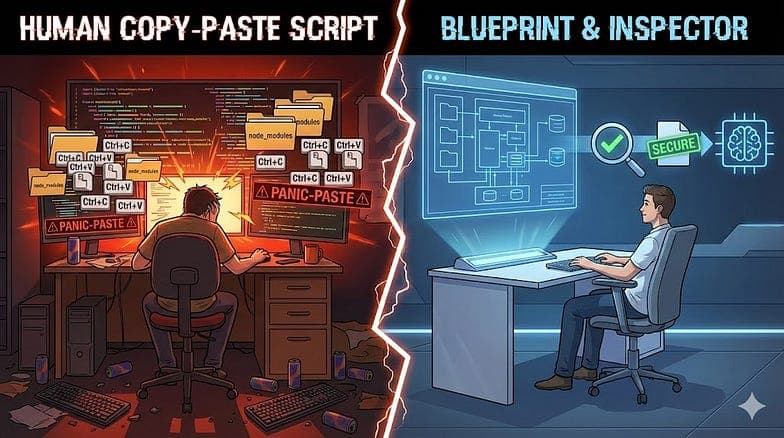
I Stopped Being a Human Copy-Paste Script
I used to manually delete node_modules at 2 AM and pray I didn’t leak secrets to LLMs. Then I built an open-source “Inspector” that treats context like production code — secrets blocked, payloads cleaned, hallucinations gone. Here’s exactly how I did it (and how you can too).

How I started treating LLM context like production code — and why I finally started sleeping again
It was 2:17 AM when the shame hit me.
Eyes stinging, screen burning, I was doing that thing we all swear we’ll never do again:
- `tree -L 3`
- Click through folders like a frantic archaeologist
- Delete every node_modules, every .env, every dist folder for the hundredth time
- Select 38 files → Copy → Paste into Claude
- Whisper a tiny prayer that I didn’t just upload my production database URL to a server farm in Virginia
The model gave me a beautiful refactor.
And then the thought landed like a brick:
“The AI is doing the engineering. I’m just the slow, error-prone human middleware moving text around.”
We have CI/CD, secret detection, code owners, dependency scanning, pre-commit hooks, SOC 2 audits…
yet when we hand context to the most powerful reasoning tool ever built, we treat it like a disposable napkin.
That night I made a promise to myself:
This stops being a ritual of shame.
It starts being a system.
What does your 2 AM look like right now — craft, or quiet chaos?
1. We don’t build skyscrapers by dumping bricks and walking away
Real architects don’t show up with a truck full of random materials and say, “Good luck.”
They hand you stamped blueprints.
They mark the load-bearing walls in red.
They tell you exactly where the plumbing lives and where you’re absolutely not allowed to drill.
For years I did the opposite with LLMs.
I backed up a dump truck of unordered files and whispered:
“There’s a system in here somewhere. Please read my mind.”
No wonder the output swung wildly — brilliant one minute, confidently hallucinating nonexistent modules the next.
It wasn’t Claude’s fault.
I wasn’t giving it architecture.
I was giving it rubble.
Look honestly at your last serious LLM session.
Did you hand it a blueprint… or the aftermath of an explosion?
2. That cold-sweat moment after you hit Send
You know the one.
You paste 1.8 MB of context.
You press Enter.
And then your brain starts its own secret scanner:
- “Wait… was there a real API key in that config?”
- “Did I just send my entire .env to a third-party logging server?”
- “Is my private key now floating in some dataset I’ll never see?”
My code velocity was skyrocketing.
My sleep quality was in free fall.
I didn’t need another prompt-engineering thread on Twitter.
I needed a gatekeeper.
3. From panic-paste to pre-flight discipline
So I did what every exhausted founder eventually does:
I stopped shipping features for a weekend and built the tool I wish had existed six months earlier.
(It’s open-source, no sign-up, no funnel — link at the bottom.)
Now, every single time I want to talk to an LLM about real code, a tiny pipeline produces three things:
3.1 The BlueprintA 10-second-readable Markdown map of the repo:what lives where, what matters for this task, what is deliberately excluded, and a three-sentence mission brief.
It’s the architectural drawing I should have been giving the model from day one.
3.2 The PayloadToken-optimized, deduped, relevance-sorted, secrets-redacted, node_modules-stripped.Exactly what I’d hand a new senior engineer on their first day.
3.3 The InspectorA grumpy little local script that sits between me and the network.It scans every payload and flat-out refuses to send anything containing:
- Hardcoded secrets
- Credential patterns
- PII shapes
- 40 MB of irrelevant garbage
If the Inspector says “no,” nothing leaves my machine.
- No override flag. No “just this once.”
- We don’t allow that with production code.
- Why did we ever allow it with LLM context?
4. When context becomes production-grade, everything changes
These days when I ask a model to trace a Heisenbug, refactor a subsystem, or design a new service, I’m no longer pleading.
I hand it clean drawings and say:
“Here’s the map. Here’s what matters. Show me what you can do.”
The jump in quality is ridiculous:
- Almost zero hallucinated file paths
- Patterns spotted that I’d forgotten existed
- Refactors that respect real boundaries, not the cartoon in my head
- 40–60 % fewer tokens for the same task
- Exactly zero post-send anxiety attacks
But the deepest change was psychological:
Once you treat context like production code, you stop asking lazy, vibe-based questions.
You stop sending feelings.
You start sending specifications.
And yes — I finally sleep through the night again.
Press enter or click to view image in full size

5. A quiet bug report to my fellow engineers
This isn’t a sermon.
It’s more like a bug report for our shared habits.
If you recognized yourself in any of this —
the 2 AM manual pruning,
the tiny panic after hitting Send,
treating production code like sacred scripture but LLM context like trash —
then please, stop punishing yourself.
You deserve a repeatable system.
Your team deserves it.
Your future self desperately deserves it.
Even if you never touch my repo, do one small thing today:
- Write a 15-line pre-flight script that greps for secrets
- Add a local context linter that strips obvious junk
- Make some version of an Inspector non-negotiable
We finally have reasoning tools that operate at a scale our brains can’t match.
The least we can do is meet them with the same discipline we already give our compilers.
6. Your turn — I’m genuinely curious
I’m just one engineer with one set of scars and one very opinionated workflow.
There are almost certainly stricter, lazier, cleaner, and more elegant solutions I haven’t imagined yet.
So tell me in the comments:
- What does your context ritual look like today?
- Do you already have an Inspector, a blueprint generator, or some other guardrail I need to steal?
- Or are you still in the copy-paste-and-pray stage like I was?
I read every reply.
Somewhere between your horror stories and mine is probably the next open-source tool we both need.
(Repo, if you want it — no newsletter, no waitlist, just code that turned my 2 AM panic into calm, repeatable craft: below first comment)
Thanks for reading this far.
If you end up building your own gatekeeper, come back and tell me how it feels to sleep again.
I’d really love to know.