
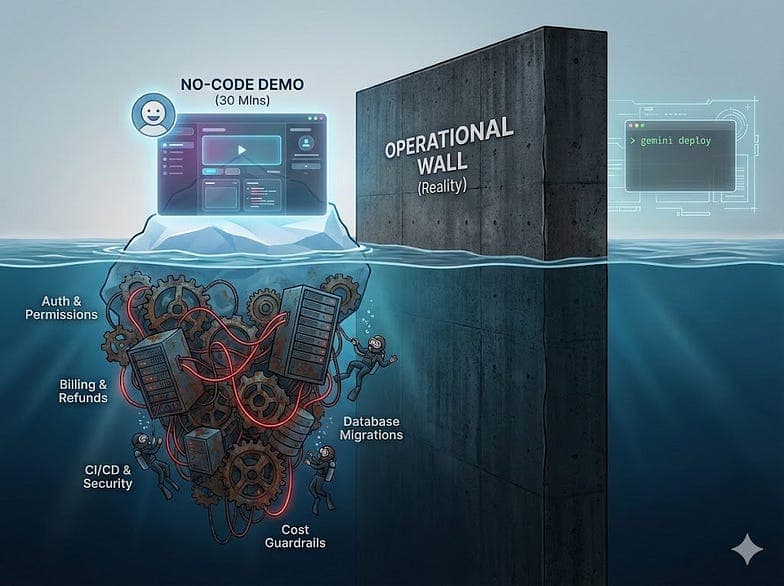
Built a SaaS in 30 Minutes? When “No-Code Hype” Meets the Operational Wall
Where no-code hype hits the operational wall: auth, billing, security, cost.

Where Vibe Coding Breaks
I’ve been seeing the same promise everywhere lately:
“No-code + AI means anyone can build an app and make money.”
It looks smooth in a YouTube demo.
It feels inevitable.
But as someone who’s shipped real systems, it also feels… dangerous.
Because a 30-minute demo is easy.
A 30-week product is brutal.
And the moment you hit that brutality, the slogan quietly changes:
“Anyone can do it.”(As long as you pay more.)
This isn’t a hit piece on one product.
It’s a reality check on where “vibe coding” breaks — not in code, but in operations.
1) Why the “peak marketing” is happening now
Hype moves like a wave.
It rises, peaks, and falls.
Right now, “anyone can build” is the best-selling story.
And competition is intense, so everyone tries to capture the peak while attention is still cheap.
But here’s what most “anyone” runs into after the demo:
- ✅ You built a UI
- ❌ Payments don’t work reliably
- ❌ Auth / roles are fragile
- ❌ Data gets messy
- ❌ Deployments feel like roulette
- ❌ A crash happens and you don’t know why
- ❌ Costs spike and you don’t know where from
So it’s not “you don’t need to code.”
It’s “you’re now exposed to risk you can’t see.”
2) The real product isn’t code. It’s operations.

The moment you go from “cool app” to paid SaaS, the real work moves here:
- Authentication & permissions (RBAC)
- Payments, refunds, webhook reliability
- Database migrations, backups, restores
- CI/CD + testing + linting + vulnerability scanning
- Observability (logs, metrics, alerts)
- Incident response (runbooks)
- And most importantly: cost guardrails
From here on, it’s not “no-code.”
It’s DevOps + security + product operations.
That’s why I use one question to filter the hype:
Is it worth paying expensive money for this — really?Does this tool reduce my operational risk… or increase it?
3) Why developers leave — and why YouTube ads target non-developers
Most developers already have a workflow:
CLI. Git. Local tooling. CI/CD. Monitoring.
They don’t need a glossy “30-minute SaaS” machine.
So the growth strategy becomes obvious:
- The target isn’t developers.
- It’s non-developers — people buying the dream.
YouTube ads sell the first dopamine hit:
“I built something.”
But when the operational wall shows up, many people feel this:
- “Wait… I didn’t build a product. I bought a shell.”“The real substance is locked — and to unlock it, I have to pay more.”
When that feeling accumulates in communities, hype doesn’t just fade.
It snaps.
4) The next phase: no-code doesn’t die — it shrinks into a funnel
Here’s what I think happens next:
- No-code hype cools down, because the market learns. Fast.
- Not everyone becomes a builder.
- Most people become one-time triers.

So the “anyone can do it” wave narrows into two groups:
A) The top: serious builders
They learn the painful parts (auth, billing, CI/CD, security).
They stop paying for “the dream” and start paying for control.
B) The bottom: casual dabblers
They want novelty. They want a demo.
They churn when reality appears.
What disappears is the middle:
The “I’m not technical but I’ll run a real SaaS” layer.
That’s an hourglass outcome.
5) The AI bubble doesn’t end. It changes shape.
This is the important nuance:
Hype may fade.But useful AI keeps compounding.
In fact, I expect we’ll see more solo developers shipping real value — because the best alternatives are moving toward:
- Local / terminal-first workflows
- Transparent toolchains
- Lower marginal cost
- Less platform lock-in
And this is where the “expensive no-code” pitch gets squeezed.
The quiet killer isn’t a better no-code platform.
It’s cheap (or free) coding agents in the terminal.
Examples that matter (as of late 2025):
- Gemini CLI: Google’s open-source terminal agent, with generous free limits (up to 60 requests/min and 1,000/day via Google account).
- Claude Code: Anthropic’s CLI workflow that understands your codebase, edits files, runs commands, and handles git — all in the terminal.
- Codex CLI: OpenAI’s lightweight terminal agent, included with ChatGPT plans, for direct project interaction.
(Note: Tools like Google’s Antigravity are more IDE-focused, showing the gravity shifting toward agentic dev workflows beyond simple no-code pages.)
So when someone asks:
“Why pay a lot, just to get a shell… when terminal agents are getting cheaper every month?”
…it’s not rhetorical.
It’s the whole market.
Closing thought
The hardest part isn’t building.
It’s keeping it alive.
And the future doesn’t look like “no-code wins” or “no-code dies.”
It looks like:
- Hype cools
- Real builders grow
- The middle collapses
- Terminal agents become the default substitute
- And the winners are the ones who can ship with cost guardrails + operational trust
If you’ve shipped a product before, you already know what I mean.