
Black Mirror: Plaything — Could a QR Code Really Hack the World?
Black Mirror imagines a QR-code apocalypse. As a Flame Glyph developer, I unpack what’s plausible today — local device disruption — and what remains fiction.

🧠TL;DR —The technical core isn’t whether a QR can reprogram minds. It’s whether an AI or service will read, trust, and act on the data encoded in that QR.
I hadn’t planned on working. Netflix was on, lights low, popcorn ready — just another night, waiting for the new season.
Then came Black Mirror Season 7, Episode 4 — “Plaything.”
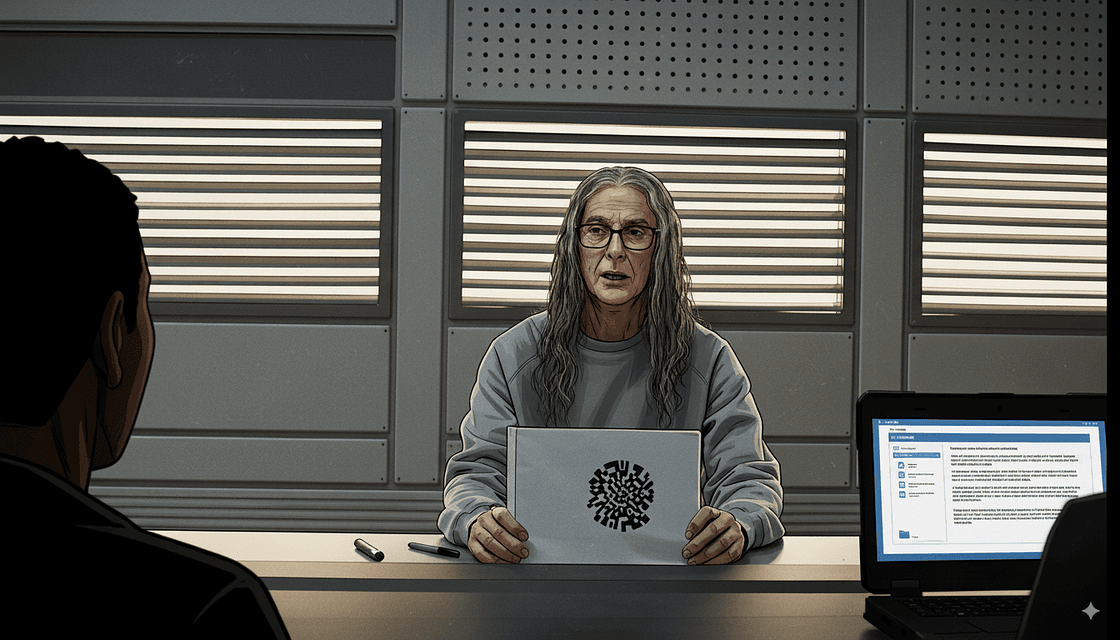
Near the end, one scene stopped me cold: a murder suspect sketches a round QR in his sketchbook. The camera lingers, the system reacts, and within twenty seconds the world flips upside down.
I sat there wide-eyed, speechless.
For a moment it felt as if the Flame Glyph concept we’ve been building had just leapt onto the screen. Our goals aren’t identical, of course — but that single image mirrored the technology we’d only imagined until now.
1. Same Language, Different Tune
Flame Glyph is our project: a visual glyph system that lets devices and AIs exchange authenticated, consent-based commands.
At first glance, the show’s conceit and our work share the same fantasy — a symbol that opens a door: a circle of pixels that doesn’t just mean something, but does something.
That’s a beautiful — and dangerous — idea.
Would you trust a single small square to act as a real door? Why or why not?
Flame Glyph: How I Taught AI to Remember with QR CodesNot a link. Not a scan. A glyph that lets AI “recall” meaning through vision.
medium.com
2. A Weapon vs. a Shield
In “Plaything”, the QR is a weapon. One scan, and the infection spreads.
We took the opposite approach. Flame Glyph is designed as a shield — manual-first, multi-layered verification, consent baked into the workflow.
Every shortcut, every “auto-open,” increases the attack surface.
Still, it’s worth asking: what if someone intentionally tried to subvert those safeguards? Not to describe methods, but to imagine the consequences when verification fails and trust becomes the weakness.
3. The Reality Check
We ran tabletop simulations with our security team — conservative scenarios only; no exploits were developed.
- One vulnerable camera? Plausible — perhaps 20–30% under specific firmware flaws.
- Multi-device spread? Possible but uncommon — roughly 5–10% in homogeneous, vulnerable fleets.
- The mass mind-hack from the show? 0% not scientifically or technically plausible.
That said, humans remain the softer target. If machines are difficult to compromise, people can still be tricked — which is where “quishing” (QR-based phishing) comes in.
4. Quishing in the Real World
Quishing is real and growing: QR codes can be used to bypass filters, redirect users to fake login pages, or deliver malicious payloads.
Industry reports and user studies document QR-based phishing embedded in documents and posters, techniques that fool scanners, and surprising levels of user trust.
The takeaway: QR is just a delivery mechanism — the real danger is what a human or automated pipeline does after decoding.
5. A Glimpse Forward — hidden-language glyphs
This goes beyond links to phishing pages.
Academic research and some private projects — including our Flame Glyph work — are exploring glyphs that encode structured, machine-readable meaning. These glyphs are visual patterns humans might miss but AI pipelines can interpret.
Unlike traditional quishing, such glyphs could carry intent that a machine might act on. Our approach with Flame Glyph is explicitly defensive — signed artifacts, verifier checks, and human consent are built in — but the change in risk surface is real and arriving faster than many expect.

This isn’t science fiction anymore — it’s a reminder that symbols can carry more than humans see at first glance.
6. The Joke and the Choice
In the lab we joke: “Give us two months and we could…” but that’s a thought experiment, not a roadmap.
Real-world, movie-style contagion would require three enabling factors:
(a) known, unpatched vulnerabilities in target devices
(b) a large, homogeneous population of such vulnerable devices
(c) an effective distribution channel
Without all three, the blockbuster outcome is highly unlikely.
Improbable is not harmless. Even with only one or two conditions, localized harms — device failures, targeted quishing campaigns, coordinated nuisance attacks — become realistic.
Publicly releasing a precise implementation would lower the bar for misuse: it shortens discovery, amplifies replication, and eases the combination of weak links across ecosystems.
For those reasons we chose not to open-source Flame Glyph. The decision was deliberate and ethical: to avoid materially increasing the risk of real-world harm while we continue hardening defenses and building consent-first patterns.
7. Between Imagination and Boundaries
Black Mirror forces the questions we prefer to avoid. Technology can chase those visions — or build the shields that stop them.
Every “door” we design asks: who do we let through, and what do we vow to protect?
🔹Methodology note: conservative tabletop sims only — no exploits developed. Numbers map plausible attack surfaces; read them as directional guidance, not proof.
🔹Practical takeaway: no auto-execute by default. Require signed artifacts + verifier checks, human approval for high-risk ops, sandboxed execution, and canary rollouts.
I may be wrong. These are my observations and tabletop estimates. If you see a hole in my logic, tell me — I want us to build the safer path together.
Because in the end, the question isn’t whether a QR can hack us — it’s whether we choose to build weapons… or shields.
Tell me: would you open this door?
Drop a comment below.