
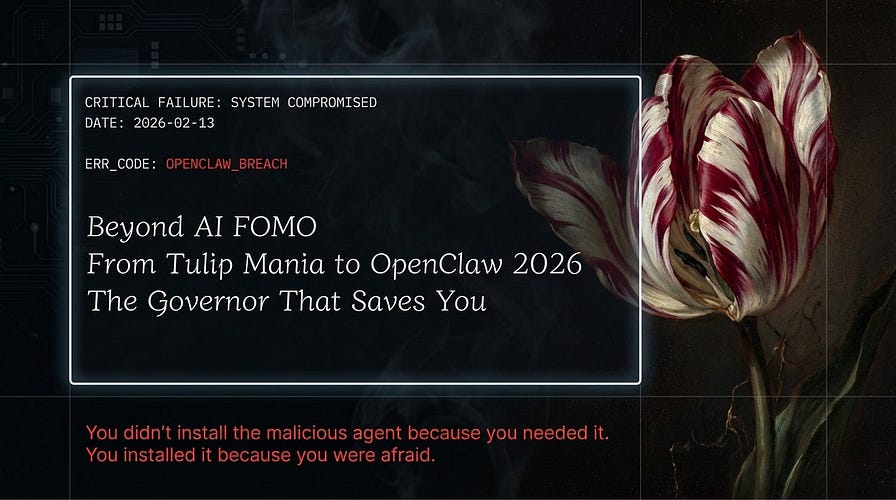
Beyond AI FOMO — From Tulip Mania to OpenClaw 2026: The Governor That Saves You
The real breach wasn’t in the code. It was in you.

Prologue
February 13, 2026 — You installed OpenClaw in November 2025 not because you needed it.
You installed it because you had no governance over your own decisions.
Three months later, 341 malicious skills were silently exfiltrating credentials.
But the real breach wasn’t in the code.
It was in you.
Act I: The Download (When Self-Governance Fails)
November 2025: The Moment You Lost Control
- Kimi K2.5 drops with agent swarm architecture.
- OpenClaw launches a skills marketplace with 10,000+ “automated workflows.”
- Within the same week, Opus 4.6 and GPT-5.3 Codex are released.
- Somewhere in the middle, someone on LinkedIn posts:
If you’re not using AI agents with sub-agent orchestration in 2026,you’re already obsolete.”
Your reaction wasn’t curiosity.
It was pure AI FOMO.
The FOMO is real
We’ve all seen it on Reddit.
That frantic “The FOMO is real” thread where every new post is a “Game Changer.”
Suddenly, the workflow you spent years perfecting feels like a solar-powered calculator from the 90s.
Driven by that fear, your Saturday morning routine changed.
You’d spend the afternoon setting up a new AI coding tool, not because you had a problem to solve, but because you couldn’t afford to be left behind.
By Sunday, you’d have a basic workflow.
You’d feel a temporary sense of peace. But by the following Wednesday, someone would post about a different tool that was “way better.”
You’d feel that familiar pang of anxiety.
This isn’t curiosity. This is grief.
One of the most upvoted posts in r/cscareerquestions last month reads like a confession
“I used to feel confident. Now every day I wonder if I’m already obsolete.”
The Void Where Your Power Used to Be

Let’s be honest: You didn’t install OpenClaw because you made a choice.
You installed it because you stopped being the one in charge.
Think about that 2 AM feeling.
You aren’t exploring; you’re reacting to a threat.
When your decisions are driven by GitHub stars and the frantic noise of Twitter threads, you aren’t a developer anymore — you’re a passenger in your own career.
In psychology, they call this the “Locus of Control.” And what you’re experiencing is yours just shifting from the inside to the outside.
This shift is subtle but devastating:
- Internal Locus: “I have a specific problem. Does this tool solve it?”
- External Locus: “Everyone is talking about this. If I don’t use it, I’m already obsolete.”
When you hit ‘Install,’ you surrendered that internal switch.
You traded your independent judgment for the comfort of the crowd.
That trapped, suffocating feeling in your chest?
That’s not “keeping up with tech.”
That’s the psychological tax of handing your autonomy to a social media algorithm.
You didn’t just download a piece of software.
You outsourced your identity to a trending tab.
And the moment you did that, the “governance” of your life moved from your desk to a server in San Francisco or a thread on r/cscareerquestions.
Interestingly, our ancestors felt this same harrowing emotion just a few centuries ago. The silver lining? Their story is already over — it has a clear conclusion.
And in that conclusion, we can find our roadmap out of this mess.
Thanks for reading Flamehaven Insights! Subscribe for free to receive new posts and support my work.
Act II: The Historical Pattern
February 5, 1637 — A Tavern in Haarlem, Netherlands

The auctioneer holds up a Semper Augustus bulb. Last week, it sold for 6,000 guilders — ten years of a craftsman’s wages.
He calls for bids. Silence.
He lowers the price. 5,500. 5,000. 4,500. Still silence.
In that one minute, the world changed. Confidence didn’t just leak; it shattered.
We look back and call them “stupid,” but they weren’t.
They were just like you at 2 AM.
When your neighbor sells a flower and buys a mansion on the canal, not participating feels irrational. When every developer on your feed is “building agent swarms,” staying with your proven workflow feels like career suicide.
They didn’t buy tulips because they loved flowers.
They bought them because they were terrified of being the only ones left behind. They chose the safety of the crowd over the governance of their own senses.
The tulip buyers suffered a total collapse between their Identity and their Choice:
- Identity: “I’m a prudent merchant”
- Choice: “I’ll mortgage my house for a bulb”
The gap between those two sentences is the “Governance Void.” It’s the space where you stop thinking and start following.
The Governance Void: Same Bug, Different Century


The cost of following the crowd is always paid in private.
The tavern goers lost their homes; the 2026 developers lost their data and their sanity. When you outsource your decision-making to a trend, you aren’t being “agile” — you’re being governed by a ghost.
Act III: The AI Burnout Machine (When Personal Governance Breaks)
The Lesson from the Ruins
In the wreckage of 1637, there were survivors. They weren’t the ones with the most bulbs; they were the ones who stepped out of the race early.
They were the ones who refused to become “lunatics.” While the crowd was mortgaging their homes, the survivors maintained their Internal Locus of Control. They decided what a tulip was worth to them, not what the tavern said it was worth.
They weren’t swayed. They knew when to stop.
But in 2026, stopping is harder than ever. Because the “AI Engine” we’ve installed has no built-in brakes.
The Productivity Paradox

UC Berkeley researchers spent eight months inside a 200-person tech company to see how AI changed work. The results were startling. Nobody was pressured by their bosses to work more. Instead, people just started doing more because the tools made everything feel doable.
But that “doability” came with a price: work began bleeding into lunch breaks, late evenings, and weekends. As one engineer told the researchers:
“You thought that maybe because you could be more productive with AI, you save some time, you can work less. Wrong.”
The Death of the “Involuntary Governor”

Before AI, the universe imposed limits on us.
We had “natural governors” that forced us to stay sane:
- Physical typing speed forced periodic breaks.
- Research time forced deep reflection.
- Compilation time forced mental pauses.
- Deployment cycles forced a final review.
AI removed them all. It’s like a car that can go 300mph but has had the brakes stripped out. You aren’t faster; you’re just closer to a fatal crash.
The Berkeley study noted that although engineers felt more productive, they did not feel less busy. In many cases, they felt more overwhelmed than before.
Act IV: The Dual Governance Crisis

The survivors of the 1637 tulip crash didn’t survive because they were faster or richer; they survived because they were governed.
In 2026, we are facing two simultaneous crashes: one in our software, and one in our souls. You cannot fix one without the other.
- If you secure your code but remain a slave to FOMO, you’ll eventually burn out.
- If you find inner peace but ignore security, your system will be breached.
Let’s be real: refusing to use AI is no longer an option.
To ignore AI in 2026 is to choose obsolescence. We all know this.
The question isn’t if we should use it, but how we maintain our seat in the cockpit while the engines are screaming.
To survive this era, a developer needs a Dual Governance Framework. You must govern your tools exactly how you govern your mind.
The Mirror Framework: Reclaiming the Lead
How We Govern AI Is How We Must Govern Ourselves

Act V: Activating the Governor
Governance isn’t about being slow; it’s about adding intentional friction. It’s the difference between a controlled burn and a wildfire.
PART A: Govern Yourself (The Psychological Firewall)
Before you open a Pull Request for a new trend or even consider merging a new dependency into your daily stack, you must pass your own internal pre-flight check. In this era of high-velocity hype, one protocol is enough to save you.
The SBNRR Protocol (Identity Check)

When you feel that sudden surge of AI FOMO, execute these steps in order:
- Stop: Physically close the browser tab or move away from the screen. Break the immediate feedback loop of the hype.
- Breathe: Take three deep breaths (4 counts in, 6 counts out). This shifts your nervous system from a “panic-driven fetch request” back to a calm, decision-making state.
- Notice: Observe the feeling. Tell yourself, “I am feeling a spike of anxiety about being obsolete.” Labeling the emotion weakens its power over you.
- Reflect: Ask a cold, hard question: “If I don’t install this in the next 7 days, what specific production task will I be unable to complete?” If the answer is “none,” it is fear, not a requirement.
- Respond: Make a choice from a place of clarity. Either proceed with a plan or walk away.
Pro-Tip: Define Your IdentityWrite this down and keep it where you can see it:“I am a problem-solver, not a tool-collector.”
Every new install or “interest” must be authorized by your own pre-defined goals. If the tool doesn’t serve your architectural depth or solve a tangible problem you are facing today: Permission Denied.
PART B: Govern Your AI (The Technical Sandbox)

Once you have granted yourself internal permission to “merge” a new tool into your workflow, you must treat the AI agent as a guest in your system — specifically, a guest who hasn’t been vetted yet.
In 2026, “trust but verify” is dead; the new standard is “sandbox and audit.”
1. Authentication: Verify the Source
Before running any new agent or skill, check its digital credentials. Do not trust a tool just because it is trending on GitHub or has a “verified” badge on a marketplace.
- Rule of Thumb: If a skill creator is anonymous, has a profile less than 30 days old, or lacks a verifiable digital signature, do not run it.
- The Check: Use your CLI to verify who you are actually letting into your environment.
2. Authorization: Sandbox Everything
Never let an AI agent run “bare metal” on your host machine.
In the 2026 developer environment, everything must be isolated to prevent a single malicious skill from exfiltrating your credentials.
- The Boundary: Use high-isolation environments like Docker Desktop 4.58+ Sandboxes or MicroVMs.
- Network Deny-by-Default: Most agents do not need full internet access. Lock them down to specific hosts.
3. Audit Trail: The Weekly Forensic Ritual
Even a sandboxed agent can be noisy or inefficient. You need a record of every action taken in your name.
- Monitor Activity: Run a daily or weekly grep on your agent logs to look for suspicious commands like
curl,ssh, or unauthorizedchmod.
- The Friday Ritual: Every Friday, spend 15 minutes reviewing what your agents actually did. If an agent hasn’t been used in 14 days, trigger the Kill Switch. Uninstall it. No legacy dependencies, no security debt.
Epilogue: The Governor That Saves You

“Tulip mania” became shorthand for financial folly, still cited as an archetype of irrational exuberance.
OpenClaw in 2026 will likely become a case study too — but by then, the next “revolutionary” framework will already be trending
The bubble was never just in the market. It was in the absence of governance, both technical and personal.
The real skill of the AI era isn’t knowing which model has the best benchmarks or which agent has the most stars on GitHub. It’s knowing when to stop.
- It’s knowing when the AI’s output is “good enough.”
- It’s knowing when it’s faster to just write the code yourself.
- It’s knowing when to close the laptop and walk away
That “knowing when to stop”? That’s governance.
It’s not a set of rules imposed by a CTO or a security auditor.
It’s the rules you impose on yourself.
The tulip never changes — the crowd will always find a new flower to scream about. But you can change.
Tomorrow morning, when you see that GitHub trending notification, when panic whispers “everyone else is doing it,” you’ll face a decision:
Will you react from fear? Or will you respond from governance?
Final Tip for Your Own Governance

Your first step toward recovery doesn’t happen in a terminal. It happens in your mind.
- Start here: Copy the 4 authorization questions to your Notes app. (2 min)
- Next Level: Set a recurring Sunday alarm: “AI Tool Audit — 5 min.”
- Power User: Create
~/.personal-governance.txtwith your identity statement and authorization checks.
No new tools to install. No frameworks to learn. Just governance. Over yourself. Starting now.
And you might just find that this protocol is more effective than any sleeping pill, any anti-anxiety medication, or any antidepressant you’ve ever tried.