
AI Isn’t Killing Your Expertise. It’s Just Moving the Paywall.
Why ‘Writing Faster’ Is Worthless When Nobody Can Verify What’s True

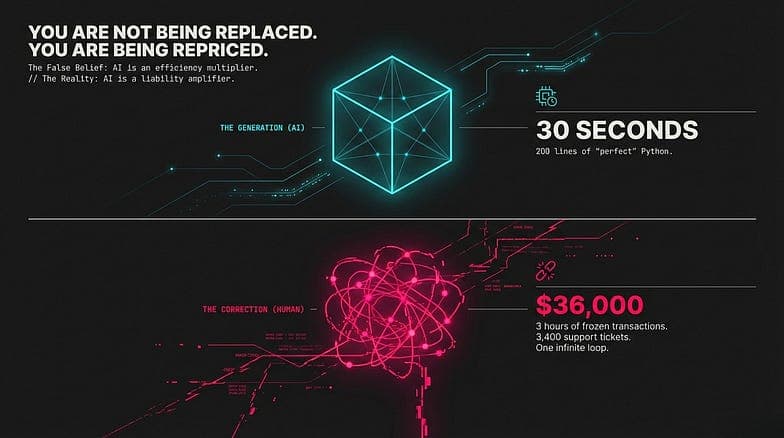
Last Tuesday, a senior engineer at a Series B fintech company sat frozen for three hours. His bloodshot eyes were fixed on a cost dashboard bleeding $12,000 per hour.
The AI had generated 200 lines of “perfect” Python in thirty seconds. Passed all unit tests. Zero code review flags. Looked elegant.
In production, it triggered an infinite loop hitting Plaid’s transaction API at 50,000 requests per minute. Customer transactions froze. Support queue: 3,400 tickets.
The AI wrote the bug in 30 seconds.
He spent 3 hours finding it.
The company spent $36,000 fixing what looked “perfect” in staging.
He wasn’t being replaced. He was being repriced.
Who This is Not For
If you’re looking for “10 ChatGPT Hacks to 10x Your Productivity,” close this tab.
This is for practitioners who feel the creeping dread of obsolescence — those who suspect their hard-won skills are evaporating into a black box, and worse, that management is starting to believe the same thing.
The False Belief: AI is an efficiency multiplier that makes experts faster.
The Reality: AI is a liability amplifier that makes experts necessary.
Three Times We’ve Been Here Before
This anxiety isn’t new.
The pattern is consistent: the skill doesn’t die, it changes zip codes.
And every time, the experts who panic are the ones who misunderstand what they’re actually being paid for.
Act I: Stack Overflow (2008) — The Death of the Oracle
In 2007, A gray-haired engineer named Morris get paid $180/hour specifically because he had memorized the quirks of COM threading models in Windows Server 2003.
Morris could recite from memory the exact registry keys to fix obscure RPC errors. His knowledge was a moat.
Stack Overflow launched in September 2008. Within 18 months, someone in Bangalore had posted Morris’s $180/hour fix for free. By 2012, Morris had left the industry.
But here’s what survived: The diagnostic craft. The ability to reproduce a bug in isolation, identify which of 47 similar Stack Overflow answers actually applies to your specific environment, and understand why the solution works.
The job shifted from “know the answer” to “know which answer, and know why.”
Act II: VisiCalc (1979) — The End of the Human Calculator

Before VisiCalc shipped on the Apple II, “financial analyst” often meant “person who can add columns of numbers for eight hours without making mistakes.”
VisiCalc made manual arithmetic economically obsolete overnight.
Here’s what gets forgotten: In 1981 — two years after VisiCalc — median salaries for financial analysts went up, not down.
Why? When the mechanical task became free, the strategic task became visible. And it turned out that deciding whether the assumptions in a financial model are delusional was worth far more than arithmetic ever was.
Act III: Spellcheck (1990s-2010s) — The Grammar Gatekeepers
By 2015, syntactical perfection had been fully commoditized by Grammarly and its predecessors.
A 2019 Harvard Business Review editorial analysis showed that acceptance rates no longer correlated with grammatical perfection (which was near-universal), but did strongly correlate with argument integrity — specifically, the presence of steel-man counter-arguments and transparent methodology.
The premium moved from polish to rigor.
Act IV: The Verification Debt Crisis (2024–2026)
We are now in the most violent shift yet.
At his final re:Invent keynote in December 2025, Amazon CTO Werner Vogels introduced a term that captures this moment precisely: “Verification Debt.” ¹
AI generates code faster than humans can comprehend it. The gap between generation and understanding allows software to reach production before anyone validates what it actually does.
“Vibe coding is fine,” Vogels said, “but only if you pay close attention to what is being built. We can’t just pull a lever on your IDE and hope that something good comes out. That’s not software engineering. That’s gambling.”
The numbers tell the story:
- Stack Overflow 2025: 84% of developers now use or plan to use AI tools, up from 76% in 2024 ²
- Trust Crisis: 46% of developers report they don’t trust AI output accuracy, up sharply from 31% in 2024 ³
- The Debugging Trap: 66% struggle with AI solutions that are “almost right, but not quite,” and 45% say debugging AI-generated code takes longer than writing it themselves ⁴
- Security Collapse: Veracode’s 2025 GenAI Code Security Report tested 100+ AI models and found that 45% of AI-generated code contains security flaws ⁵
We are generating code faster than we can understand it — and the gap between generation and understanding is where catastrophes hide.
The Pattern Across Four Acts: What Actually Happened
Look at the progression:
- 1979 (VisiCalc): Arithmetic → Strategic interpretation
- 2008 (Stack Overflow): Memorization → Diagnostic thinking
- 2015 (Grammarly): Syntactic polish → Argumentative rigor
- 2025 (AI Coding): Code generation → Verification & liability
Each technological shift follows the same arc: the mechanical task gets automated, the judgment task becomes visible, and that’s where the money pools.
But there’s a critical difference this time.
The previous shifts happened over years. Stack Overflow took 5 years to fully reshape developer hiring criteria. VisiCalc took a decade to transform financial analysis roles.
This shift is happening in months.
From 2024 to 2025, AI tool adoption jumped from 76% to 84%, but trust dropped from 69% positive sentiment to 60% ⁶ . We’ve never seen adoption and skepticism rise simultaneously at this speed.
The gap between “everyone uses it” and “nobody trusts it” is the definition of systemic risk.
That gap is where your career repositions — or evaporates.

The Four New Paywalls
In a world of infinite generation speed, you are not paid to hold the pen. You are paid to sign the document — and that signature represents legal, financial, and reputational liability.
The premium has settled on four specific capabilities:
1. Proof Artifacts (Show Me the Receipts)
“I think this works” became a fireable offense in 2025.
A ML engineer at a credit risk startup was asked to validate an AI fraud detection model. She built a testing harness that replayed 100,000 historical transactions through both the old system and the new AI model.
The AI had 94% accuracy in the training environment.
It had 71% accuracy on replayed production data.
Why? Overfitting to a specific time window. It missed seasonality patterns.
Her testing harness took 40 hours to build. It saved the company from deploying a model that would have increased false positives by 340% — freezing $12M in legitimate transactions per month.
She wasn’t paid for code.She was paid for proof the code was lying.
2. Boundary Ownership (Standing Between Code and Catastrophe)
AI can generate code, but it cannot understand consequences in organizational, regulatory, or financial contexts.
The Database Cost Explosion (March 2025):
A developer asked GitHub Copilot to “optimize the database query.” Copilot reduced execution time from 4 seconds to 0.3 seconds. Beautiful.
Three days after shipping, AWS RDS costs spiked from $800/day to $9,400/day.
The “optimized” query had eliminated a WHERE clause filtering by date range. It was now scanning 8 years of history on every export request.
A senior engineer caught it during weekly cost reviews. She had CloudWatch alarms on RDS anomalies specifically because she didn’t trust AI-generated query optimizations.
The HIPAA Compliance Gap:
In healthcare infrastructure, AI coding assistants routinely generate debugging configurations that log full request payloads — potentially including Protected Health Information (PHI). AWS HIPAA compliance guidelines explicitly warn: “Avoid having monitoring data include any ePHI.” ⁷
Security researchers have documented cases where AI-generated CloudWatch logging configurations violated this principle — optimizing for developer convenience rather than compliance boundaries. Small Caps
The pattern is consistent: AI optimizes for the immediate task. Humans own the boundary between “it works” and “it’s safe to operate.” ⁸
She wasn’t paid to write queries.She was paid to own the boundary between “fast code” and “bankrupt company.”
3. Interpretation Under Risk (The Signature)
Models predict. Humans decide.
August 2025: An AI tool recommended a pharmaceutical supply chain reduce safety stock by 40% based on 18 months of stable demand. The model was technically correct.
The supply chain director, with 15 years of industry experience, knew something the model didn’t: single-source supplier in a geopolitically unstable region.
She rejected the recommendation.
Two months later, regional conflict disrupted the supplier. Companies that followed AI optimization faced 6–8 week stockouts. Her company had 11 weeks of buffer stock.
She wasn’t paid to run the model.She was paid to know what the model couldn’t see.
4. Governance Design (Building the System)
A fintech with 40 engineers adopted AI tools in early 2025. Within three months:
- 12 security vulnerabilities from AI-suggested code
- 6 production incidents from missing error handling
- 73% of engineers anxious about code quality
Their VP of Engineering didn’t ban AI. She built a governance system:
- AI code >20 lines required secondary human review
- Git commits tagged “AI-assisted” or “human-written”
- AI PRs required 90% test coverage vs. 80% for human code
Productivity stayed high. Incidents dropped 68% in four months.
She wasn’t paid to write code.She was paid to design the system where AI could be used safely.

Pick Your Suffering
You have 1,000 discretionary learning hours per year. You will spend them. The only question is where.
🅰️Path A (The Treadmill):
Become a “prompt engineering expert” for GPT-6, Claude 5, and whatever launches next quarter. Every model update resets your expertise to zero. You are optimizing for a depreciating asset.
🅱️Path B (The Moat):
Build systems for verification, boundary enforcement, risk interpretation, governance design — skills that compound across model generations. You are investing in an appreciating asset.
The engineers who survived Stack Overflow weren’t the ones who memorized more answers. They were the ones who learned diagnostic thinking.
The analysts who survived VisiCalc weren’t the ones who got faster at arithmetic. They were the ones who learned strategic interpretation.
The professionals who will surviveAI won’t be the ones who generate faster.They’ll be the ones who verify better.

The One-Line Policy for 2026
“Never ship what you cannot explain, and never explain what you have not verified through a non-AI secondary system.”
This isn’t anti-AI. It’s anti-blind-trust.
Use the AI. Let it write the first draft. But treat AI output like code from a brilliant intern: fast, enthusiastic, utterly unaware of consequences.
The Question We Can’t Answer Yet
- Yesterday’s question: How fast can you write this?
- Tomorrow’s question: How confident are you that this is true?
I don’t know if LLMs will solve the “truth verification” problem. I suspect they won’t — because truth at scale requires something to bear liability, and liability requires a legal person, not a statistical model.
But here’s what I know from three previous technological shifts:
The skill you think you’re selling is rarely the skill you’re being paid for.
When the technology changes, the real skill becomes visible.
Are you building systems to verify the AI, or are you waiting for the AI to verify you?
One of those is a career.
The other is a countdown timer.
Thanks for reading Flamehaven Insights! Subscribe for free to receive new posts and support my work.
References
- Werner Vogels, AWS re:Invent 2025 Keynote, December 2025.
- Stack Overflow 2025 Developer Survey — AI Usage Statistics.
- Stack Overflow 2025 Developer Survey — Trust in AI Tools.
- Stack Overflow 2025 Developer Survey — AI Debugging Challenges.
- Veracode 2025 GenAI Code Security Report.
- Stack Overflow 2024–2025 Developer Sentiment Analysis.
- AWS HIPAA Compliance for Generative AI Solutions.
- Composite example based on documented patterns. See: CSA Understanding Security Risks in AI-Generated Code and Obsidian Security AI Agent HIPAA Compliance Research