
2026 CRM AI: From Seats to Service (Why Undo Beats IQ)
In 2026, CRM AI won’t be won by smarter models—but by Undo. This essay explores why enterprise adoption shifts from IQ to liability, how “Service as a Software” replaces SaaS, and why seatbelt layers decide who actually ships AI in production.

🧠TL;DR
CRM AI in 2026 won’t be won by the smartest model.
It’ll be won by whoever ships Undo — as infrastructure.
Adoption doesn’t flip when AI gets more miraculous.
It flips when AI becomes like air — always there, boring, and trusted.
And CRM isn’t a demo environment.
It’s where real money moves, real customers get touched, and one confident wrong action becomes a quiet disaster.
The shift is bigger than “AI features.” It’s a business model reset:
- Seats → Service
- Tools → Digital labor
- Prompts → Contracts
The winners won’t sell magic.
They’ll sell the seatbelt layer: Default · Standard · Liability.
The 60-Second Problem (Why CRM Makes This Real)
Imagine this:
Your CRM agent misfires and sends a 90% discount to the wrong segment.
Sales sees it. Customers share screenshots. Finance gets pinged.
You have about 60 seconds before it becomes a “real incident.”
You don’t need a smarter model in that moment.
You need something brutally specific:
A safe Undo.
Not vibes. Not apologies. Reversal.
1) The CRM Moment: AI Stops Being “A Tool” and Becomes Labor
For decades, CRM pricing was simple: pay per user seat.
But agentic CRM breaks that logic.
If the work is being done by non-human workers (agents), the economic unit isn’t “a seat.”
It’s an outcome.
That’s why the most important story in CRM AI isn’t “better reasoning.”
It’s who takes responsibility when reasoning turns into action.
A copilot can be wrong and you can ignore it.
An agent can be wrong and your system will still execute it.
That’s the difference between interesting AI and operable AI.
2) What Salesforce Is Really Selling With Agentforce
In the Agentforce narrative (and similar pushes across the market), the pitch is clear:
- AI agents that don’t just answer — they complete work
- A move toward usage/outcome-style pricing (credits)
- “Service-as-a-Software” replacing “Software as a Service”
But here’s the hidden hinge:
When software becomes labor, liability becomes product.
If an agent can change a booking, issue an offer, modify a record, or trigger a workflow…
then “How smart is it?” stops being the buying question.
Buyers ask:
When it’s wrong, can I undo it — instantly — and prove what happened?
That’s not a nice-to-have.
That’s the contract.
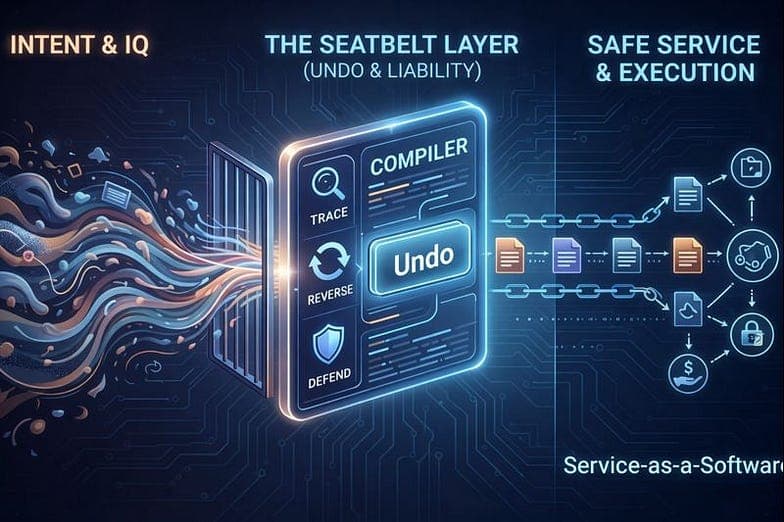
3) The Real Competitive Moat: The Seatbelt Layer
When regulation tightens, buyers don’t pay for the 0–60 demo.
They pay for the seatbelt.
So what is the seatbelt in system terms?
It’s the layer that turns AI output into safe-to-act-on work with guardrails you can trace, undo, and defend.
In my terms, it’s a Felt Compiler:
Not a new model.
A system that compiles messy human intent into action-ready execution through:
- safety checks by default
- provenance you can point to
- rollback paths (real Undo, not vibes)
- audit trails
- human escalation when confidence drops
The real moat isn’t smarter models.It’s the infrastructure that makes wrong actions quietly reversible.
This is how AI stops being “optional” and becomes environment.
This is how AI becomes air.
4) Default · Standard · Liability: The 3 Gates CRM Buyers Actually Want
These are not philosophical principles.
They’re procurement questions.
Default (Is it already there?)
No extra rituals. No copy/paste ceremonies.
- The agent runs inside the workflow
- Approvals/reviews are built into the UX
- Safety stops are the default behavior
Standard (Does it behave the same everywhere?)
CRM is a toolchain, not an app.
- Every run emits the same event schema(Prompt → Context → ToolCall → Decision → Action → Result)
- Outputs carry provenance + confidence + known vs guessed
- Policy, auth, and data boundaries stay consistent across tools
Liability (Who owns failure?)
This is where adoption flips.
- Undo exists for chains of actions (not just one step)
- Audit trails reconstruct who / what / why
- Responsibility is legible (RACI + escalation paths)
If you can’t answer those three, your AI can still be impressive.
It just won’t be deployable at scale.
5) What Microsoft / HubSpot / Zendesk Are Really Optimizing For
Different vendors, same trajectory: operability around inference.
- Microsoft: control planes + identity governanceNot “more agents everywhere,” but “agents you can manage.”Least privilege. Policy boundaries. Compliance surfaces.
- HubSpot: intent-to-action for non-technical usersSMB buyers won’t write prompts. They’ll express intent.The product must translate “what I mean” into safe workflows.
- Zendesk: resolution, memory, and rollbackCustomer ops isn’t about “answers.”It’s about closing the loop without breaking trust — and undoing fast when you do.
Major players like Salesforce (with the Einstein Trust Layer) are already building in this direction:
auditability, moderation, and governance —
not because it’s trendy,
but because agents touch real money.
Notice the pattern: nobody serious is rushing “full autonomy everywhere.”
The market is converging on one idea:
The winning agent isn’t the boldest one. It’s the most reversible one.
6) Undo Doesn’t Just Reduce Risk. It Increases Permission.
Here’s the paradox most teams miss:
When you can’t undo, you must move slowly.
When you can undo, you can automate aggressively — safely.
Undo is not only a safety feature.
It’s a growth enabler.
It’s what makes outcome-based pricing survivable.
It’s what turns “we might break something” into “we can roll it back.”
Quick Recall (before you scroll away)
- Moat = Undo Infrastructure
- Shift = Seats → Service, Tools → Labor, Prompts → Contracts
- 3 Gates = Default · Standard · Liability
7) In the next post: turning intent into an Execution Contract (not a prompt)
Most teams stop at “prompting.”
But prompts are conversation — not accountability.
In the next post, I’ll show the exact workflow I use to compile intent into an Execution Contract the system can’t “hand-wave” away.
What I’ll include:
- A non-dev-friendly Intent Contract YAML (heavily commented)
- Marketing leads can approve it
- Finance + Legal can defend it
- The full chain: Prompt → Contract → Safe Plan → Execution → Evidence + Undo
- The common CRM failure modes (segmentation, discounting, outreach) — and how to design Undo that can reverse a chain of actions in minutes
Not “better words.”Not “smarter chat.”Safer execution — with Undo baked in.
Closing
Ultimately, CRM AI becoming “air” isn’t just a win for vendors or a victory for margins.
It’s the moment the operator — the person worried about rent, healthcare, and their future — regains control at work.
When the system takes responsibility for the “miracle,”
the human is finally free to focus on meaning — and the decision.
In 2026, the question isn’t who builds the fastest engine.
It’s who lays the frictionless path: defaults, standards, and liability you can trace, undo, and defend — so ordinary people can move without fear.
Miracles get applause.Undo gets adoption.Air gets markets.