
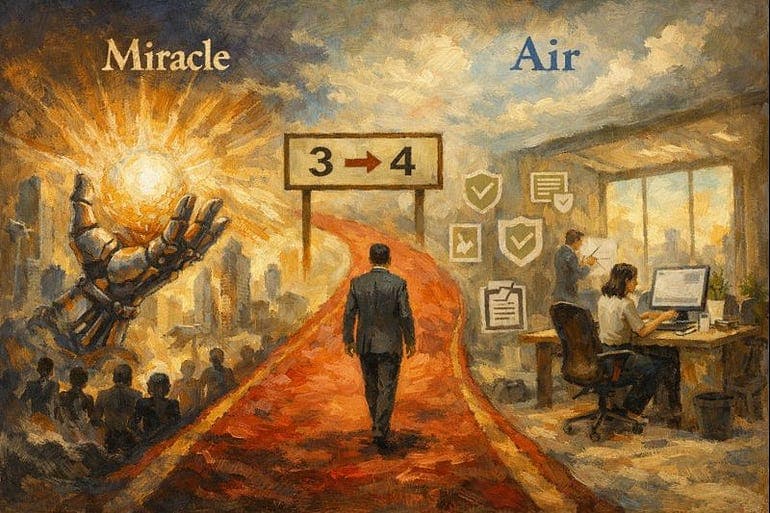
2026 AI Adoption from Miracle to Air
AI won’t go mainstream in 2026 because models get smarter. It’ll happen when AI becomes “air” - default, standardized, and liability-owned.

The 3→4 threshold isn’t intelligence.It’s Default · Standard · Liability —and the moment responsibility shifts away from the user.AI doesn’t stall because it stops improving.It stalls because people won’t cross the linefrom“interesting” to “dependable.”In 2026, adoption won’t be decided by smarter models,but by who removes friction, owns failure,and makes AI feel safe enough to fade into the background.That’s the part most debates miss.
1. Why “Better Models” Keep Missing the Point
If I had to bet on the most important AI feature of 2026,
it wouldn’t be a bigger model.
It would be Undo.
Not because I’m anti-AI.
Because I’ve met production.
And production is where “wow” goes to get audited.
- There’s a familiar frustration inside AI circles: “People don’t appreciate how fast this is advancing.”
- And a familiar response outside the bubble: “Maybe. But it still feels optional. And sometimes… risky.”
Both sides are, annoyingly, right.
AI capability is real.
Public skepticism is also rational.
The mistake is treating this as a permanent culture war —
builders vs everyone else.
Humans don’t freeze in place.We move. We adapt. We copy what works.
2. Adoption Is a Threshold, Not a Debate
Adoption doesn’t happen when a technology becomes more miraculous.
It happens when the technology becomes less noticeable —
when it becomes air.
That shift is a threshold shift:
- 3 points: “Interesting. But not my life. A tool I might use.”
- 4 points: “If this disappears, my day gets worse. It’s part of the environment.”
Most markets live in 7:3 (watchers vs users).
But the flip happens when 3 becomes 4 —
when “some people” becomes “enough people.”
And here’s the part most tech commentary skips:
3→4 isn’t a small numeric increase.It’s the moment social proof starts crushing resistance.
- At 30% usage, you look like an enthusiast.
- At 40%, you start looking like the one falling behind.
So the 2026 question isn’t
“How miraculous is AI?”
It’s:
What melts friction so reliably that 3 becomes 4?
History gives us three oddly perfect scenes.
Each was dismissed at first.
Each became global common sense.
None of them won because the tech got cooler.They won because the system changed.

3. Scene 1: Closed Captioning — when “accessibility” stopped being a fence

The First Closed Caption Decoder — 1980 Sears TeleCaption
For years, captions were framed as a special service — important,
but “for someone else.”
Early systems could require extra hardware.
Production costs were real.
And for many viewers, captions felt intrusive:
- “It blocks the screen.”
- “It’s not for me.”
- “I support it… but I won’t turn it on.”
That’s 3 points: moral agreement, low personal adoption.
Then the turning point wasn’t emotional storytelling.
It was default installation, pushed by regulation —
caption capability became “just there.”
No extra box, no extra friction.
And once it became default, people discovered a side effect:
Captions weren’t only for accessibility.
They became about privacy, concentration, and real life:
- watching silently in a loud bar
- watching a movie while someone’s asleep
- learning a language without feeling lost
- consuming content quietly in shared spaces
A “special accommodation” became a universal convenience.
✅ 3→4 mechanism: Default + friction removal
4. Scene 2: Emoji — when a “toy” became human grammar

Early emoji were fragmented — platform-specific, inconsistent, sometimes broken.
You’ve felt the real problem if you’ve ever sent a heart
and watched it arrive as a blank square:
“My emotion arrived corrupted.”
The public doesn’t adopt a language that breaks mid-sentence.
So emoji lived in the 3-point zone for a while: cute, childish, for certain circles.
Then emoji became standardized.
Unicode didn’t make emoji more poetic.
It made emoji reliably interpretable across ecosystems.
And when OS keyboards surfaced emoji as default input,
emoji stopped being a feature.
They became emotional punctuation — a global, low-bandwidth way to add tone to cold text.
Meaning stopped breaking.
✅ 3→4 mechanism: Standard + default input
5. Scene 3: Open source infrastructure — when “free” learned to wear a name tag

Before software became magic, it became manageable.
In the 90s, open source often sounded like:
- “patchy”
- “community-built”
- “who’s responsible when it breaks?”
Enterprises didn’t reject open source because it was weak.
They rejected it because it was liability-shaped.
The question wasn’t performance. It was:
“At 3 a.m., who picks up the phone?”
That’s 3 points: respect for the tech, refusal to bet the business.
Then “free” got something priceless: accountable operators— support, SLAs, governance, maintenance,someone whose name you can put in a procurement doc without getting laughed out of the room.
The tech didn’t become magical.
It became safe to depend on.
Failure ownership became visible.
✅ 3→4 mechanism: Liability + operability
6. The pattern: “miracle” becomes “air” when the system changes
People don’t adopt miracles.
They adopt environments.
And environments are built from three ingredients:
- Default — it’s already there
- Standard — it works the same everywhere
- Liability — failure doesn’t land on the user’s neck
And in 2026, those three ingredients won’t be a philosophy —
they’ll be a purchase order.
7. 2026 won’t be “capability explosion.” It’ll be liability + regulation pressure.
2026 won’t be about AI getting smarter overnight.
It will be about AI getting governed overnight.
Gartner—one of the most cited IT research and advisory firms—puts the coming liability wave bluntly.
By the end of 2026, “death by AI” legal claims could exceed 2,000,with some summaries placing the figure closer to 1,000+.
The exact number matters less than the direction: liability becomes the forcing function for adoption.
At the same time, Gartner expects governance pressure to show up inside products:
- 40% of enterprise applications will include task-specific agents by 2026 — embedded, workflow-bound, not roaming autonomy.
- The “skills paradox” intensifies: through 2026, 50% of global organizations may require AI-free skills assessments.
- By 2027, fragmented AI regulation is expected to cover 50% of the world’s economies, driving sustained compliance investment.
The forcing function isn’t hype. It’s risk.And risk doesn’t spread adoption evenly— it concentrates it.

8. Adoption in 2026 Will Be Narrow — but Deep
So the real question becomes: where does 3→4 happen first —
when the cost of being wrong finally has a price tag?
Expect the earliest 3→4 threshold crossings where risk can be bounded, reviewed, and owned:
- internal enterprise tools
- task-specific workflows
- human-in-the-loop review queues
- audit-ready environments
- rollbacks and approvals
These are the places where Default · Standard · Liability can actually ship as part of the environment — not as a promise.
And if you want to know where 2026 goes next, don’t guess — read the rulebook being written in Washington.
9. The U.S. Signal: Patchwork vs Preemption Becomes a Market Event
In the U.S., that rulebook isn’t forming slowly in the background anymore — it’s turning into a market event in real time.
It’s becoming a market-moving conflict.
On December 11, 2025, a White House Executive Order signaled federal pressure against the state-law patchwork.
It even called for a dedicated AI Litigation Task Force to challenge certain state AI laws.
Whether it can actually preempt or overturn those statutes is legally complex — but the signal to buyers is clear:
this is getting contested, not clarified.
Meanwhile, states keep legislating.
Stanford’s AI Index reports that state-level AI-related laws more than doubled to 131 in the past year.
Net effect: not less regulation — more uncertainty.
And uncertainty changes buying behavior.
When the law is moving, buyers don’t pay for the 0–60 demo.
They pay for the seatbelt.

10. The seatbelt layer (and the name I use for it)
So here’s the product question: what is the seatbelt, in system terms?
It’s the layer that turns “AI output” into safe-to-act-on work —
with guardrails you can trace, undo, and defend.
That’s what I call a Felt Compiler.
Not a new model.
A system that takes messy human intent and compiles it into action-ready output through:
- safety checks by default
- provenance you can point to
- rollback paths (real Undo, not vibes)
- audit trails
- human escalation when confidence drops
It’s not an industry term (yet). Good.
Categories get won by whoever names the pain correctly.
11. What this looks like in the wild (early signals)
You can already see companies building the “seatbelt layer”:
- Microsoft Azure AI Content Safety: Groundedness checks that flag ungrounded outputs — and, in some setups, enable correction workflows — shifting from “generate” to verify and fix.
- Salesforce Einstein Trust Layer: Comprehensive audit trails logging prompts, outputs, and safety steps — turning clever AI into operable, defensible A
- Anthropic Constitutional Classifiers: Guardrails baked in as a core system layer — robust against jailbreaks, with transparent trade-offs (cost, occasional refusals).
Notice the pattern: nobody serious is rushing “full autonomy everywhere.”
Even Gartner warns a large share of agentic projects may be canceled by 2027 — cost, unclear value, and risk controls will kill the vibe.
That’s the blueprint:
2026 winners promise accountable work, not unlimited agency.
And yes — this is why Undo remains my favorite AI feature.
Not distrust. Just respect for human reality: tired, rushed, one confident wrong answer away from a quiet disaster.

12. Forced adoption is still adoption (and it strengthens the thesis)
Some people think regulation “slows AI.”
More accurate: regulation changes the shape of AI adoption.
It moves the market away from miracle demos and toward compliance-grade environments where:
- defaults exist
- standards are enforced
- responsibility is legible
So yes — 2026 might delay the “everyone loves AI” storyline.
But it can accelerate something more important:
dependable air
AI that becomes boring in the best way —
because it’s reliable enough to disappear into the workflow.
Miracles get applause.
Air gets markets.
The 2026 litmus test (Default · Standard · Liability)
Ask any AI product:
- Default: Is it embedded where life/work happens — or is it still a copy/paste ritual?
- Standard: Are outputs reliably interpretable across tools and contexts (provenance, confidence, known vs guessed)?
- Liability: When it fails, who owns the fix — and what protects the user (rollback, audit trails, escalation, recourse)?
If it can answer those three, it can push people from 3 → 4.
If it can’t, it may still be brilliant.
But it will stay — quietly — a club.

Closing
Ultimately, AI becoming “air” isn’t a win for developers or a victory for the bottom line.
When the system takes responsibility for the “miracle,” the human is finally free to focus on the meaning — and the decision.
In 2026, humanity won’t stop adapting to AI.
The question is who will lay the frictionless path: defaults, standards, and liability you can trace, undo, and defend.
So ordinary people can move without fear.
That’s when the seatbelt matters more than the speedometer.
Miracles get applause.
Air gets markets.
Share
Related Reading
AI Signals & Market Shifts
Is MCP Really Dead? A History of AI Hype — Told Through the Rise and Fall of a Protocol
AI Signals & Market Shifts
Beyond AI FOMO — From Tulip Mania to OpenClaw 2026: The Governor That Saves You
AI Signals & Market Shifts